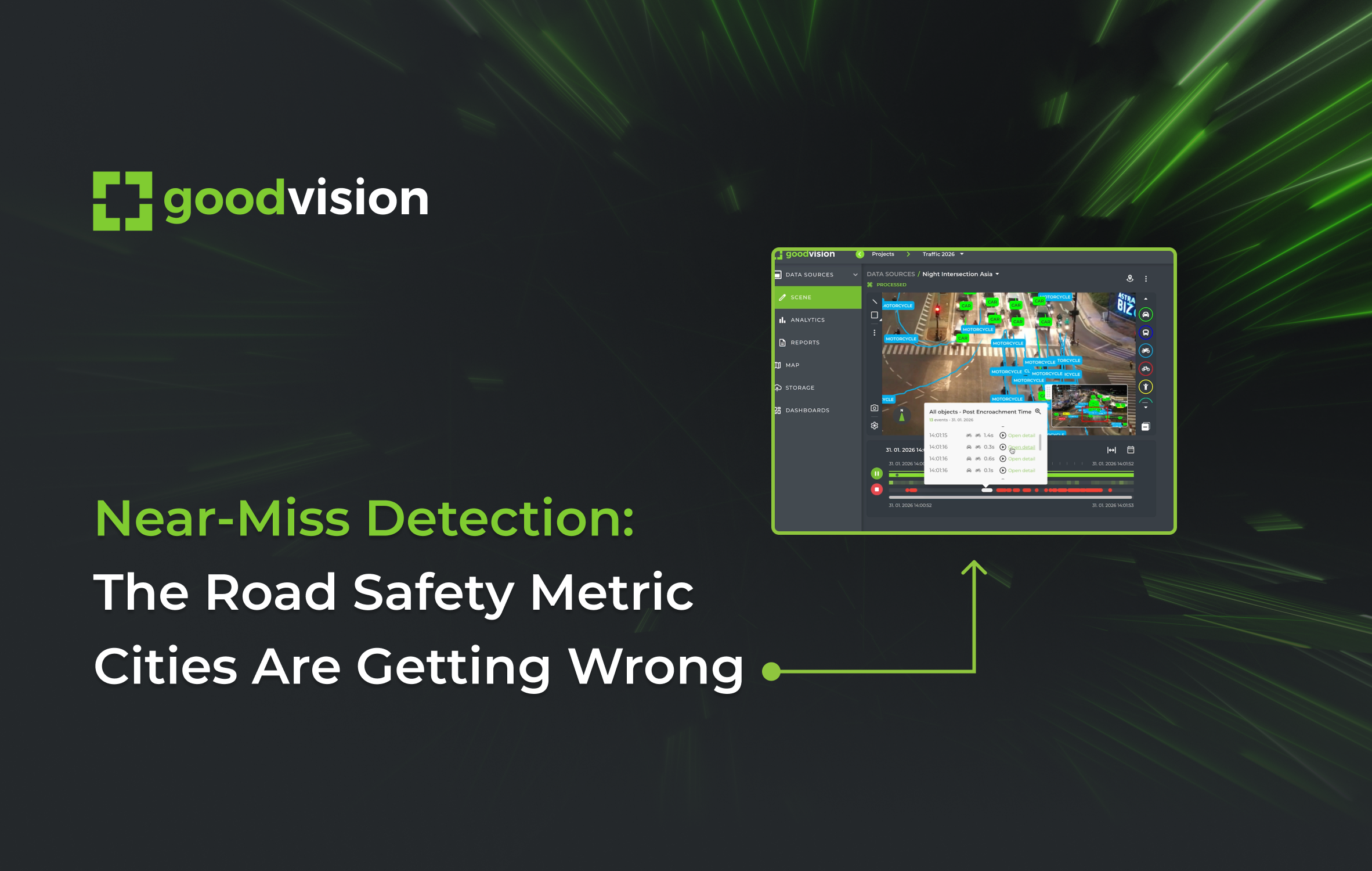
Every serious road collision is preceded by dozens of near-misses that nobody recorded. A cyclist who braked hard at a junction. A pedestrian who stepped back just in time. A van that cut across a turning lane and missed a motorcycle by a metre. These events happen constantly, on every road network, every day. In most cities, they disappear without trace.
This is the fundamental problem with how road safety is currently measured. Authorities and consultancies rely on collision records as their primary dataset. But collision data is retrospective, sparse, and heavily underreported. By the time a pattern becomes statistically visible in casualty figures, the harm has already happened. Repeatedly. Road safety engineers are, in effect, treating symptoms while the disease goes undetected.
Systematic near-miss detection has existed as a concept for decades. The obstacle has always been cost and scale. Analysing conflicts manually from video requires trained observers, hundreds of analyst hours, and budgets that most projects cannot support. That constraint is now gone. The question is whether practitioners know how to use what's available.
Why Collision Data Alone Will Always Fail You
Reported injury collisions represent a fraction of actual road conflict events. Research consistently places this ratio at 100:1 or higher: for every serious injury collision, the same location generates hundreds of measurable conflict events. Relying on the injury record to identify risk is like trying to forecast a flood using only data from the days the levee actually broke.
The statistical problem compounds over time. A single signalised junction in a busy urban network might record one or two serious collisions over a three-year monitoring period. That's not enough data to draw any defensible conclusions about intervention effectiveness. Meanwhile, the same junction might generate thousands of measurable near-miss events, rich enough to detect patterns, model risk, and evaluate countermeasures with genuine confidence.
There is also a classification problem. Collision data records outcomes, not behaviours. It tells you a cyclist was struck, but not that the junction geometry consistently forces cyclists into the path of left-turning HGVs. Conflict data tells you exactly that. And it tells you before someone dies.
The Metrics That Actually Measure Conflict
Serious near-miss analysis depends on two established safety metrics: Post Encroachment Time (PET) and Time to Collision (TTC).
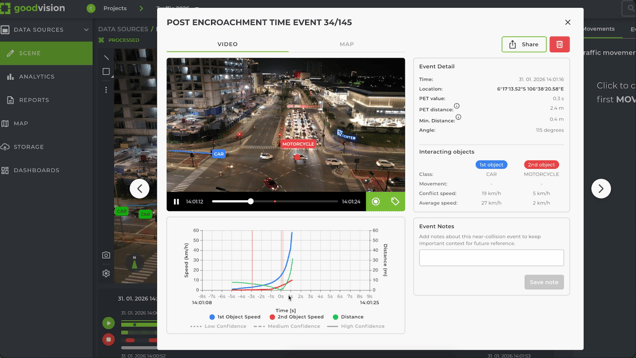
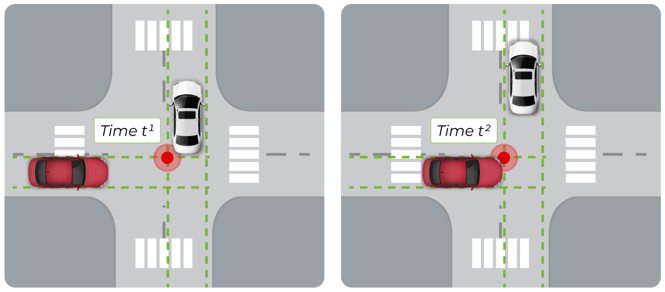
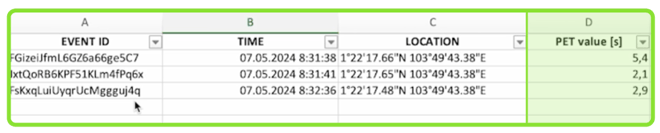
PET measures the time between when one road user leaves a shared space and when another enters it. A PET under 1.5 seconds is typically classified as a serious conflict. TTC measures how long before a collision would occur if both objects maintain their current trajectory and speed. A TTC under 1.5 seconds again signals genuine danger.
These are not new metrics. They have been standard in academic traffic safety research for decades. What has changed is the ability to compute them at scale, automatically, from standard video footage. Where a manual observer might code 30-40 conflicts per hour of video, AI-based analysis processes the same footage in minutes with consistent, repeatable methodology.
The output is not just a conflict count. It is a full spatial and temporal record: where the conflict occurred within the junction, which vehicle classes were involved, the speed differentials, the direction of approach. That granularity is what makes intervention design defensible.
Why Most Deployments Still Get It Wrong
Despite the tools existing, near-miss analysis is routinely misapplied in three ways.
Treating it as a post-hoc exercise. Near-miss detection is most valuable as a continuous monitoring function, not a one-off study. A single survey captures a snapshot. Conditions vary by time of day, season, and traffic composition. Continuous monitoring captures the full distribution of conflict events and allows before-and-after comparison of interventions with statistical rigour.
Using the wrong detection categories. Most standard vehicle classification systems are built for flow counting, not safety analysis. A system that cannot reliably distinguish cyclists from pedestrians, or motorcycles from cars, will generate conflict records that misrepresent the actual risk profile, particularly at locations where vulnerable road user interactions are the primary concern.
Conflating camera coverage with analysis coverage. Many authorities assume that because they have cameras on a junction, they have safety monitoring. Camera presence and conflict detection are entirely different things. Raw video is not analysis. Without AI processing that extracts trajectory data, computes PET and TTC values, and maps conflict zones, the footage is just storage.
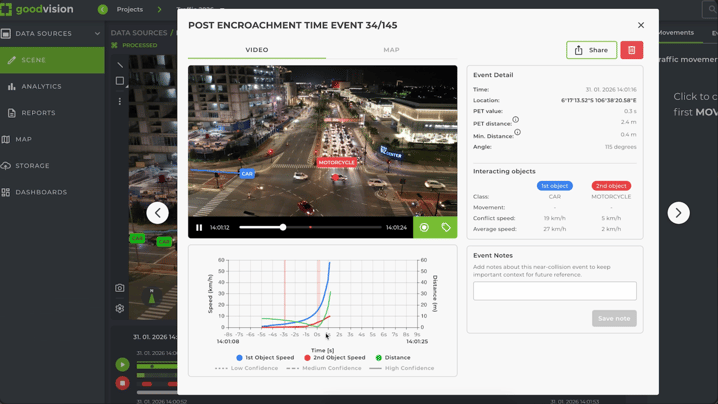
How GoodVision Applies This in Practice
GoodVision's Traffic Safety Suite is built around Post Encroachment Time (PET) conflict detection, applied to both live monitoring and recorded video. The system processes footage from any existing camera infrastructure (no proprietary hardware required) and extracts full trajectory data for every detected road user across eight vehicle classes, including pedestrians and cyclists.
For continuous monitoring applications, Live Traffic hardware provides on-site AI processing with conflict alerts delivered in under one second. For survey-based safety studies, Video Insights processes uploaded footage through parallel cloud infrastructure, returning complete trajectory and conflict datasets in one to two hours regardless of video length.
The accuracy benchmark across traffic counts and classifications is 95%+, which matters in safety applications where misclassified road user types produce misleading conflict records. The system also delivers a 1000x reduction in data footprint compared to raw video retention, which matters for authorities managing long-term monitoring programmes.
GoodVision cuts the cost of near-miss detection by 80% compared to traditional forensic methods, and identifies conflicts 90% faster. For consultancies pricing safety studies into project budgets, those figures open up work that was previously unviable to commission.
If your road safety assessments still depend primarily on collision records, you're working with the wrong dataset. GoodVision's Traffic Safety Suite gives you the conflict detection infrastructure to identify risk before it becomes a statistic.
Book a demo at goodvisionlive.com/request-demo/ and run your first near-miss analysis on existing footage within days.