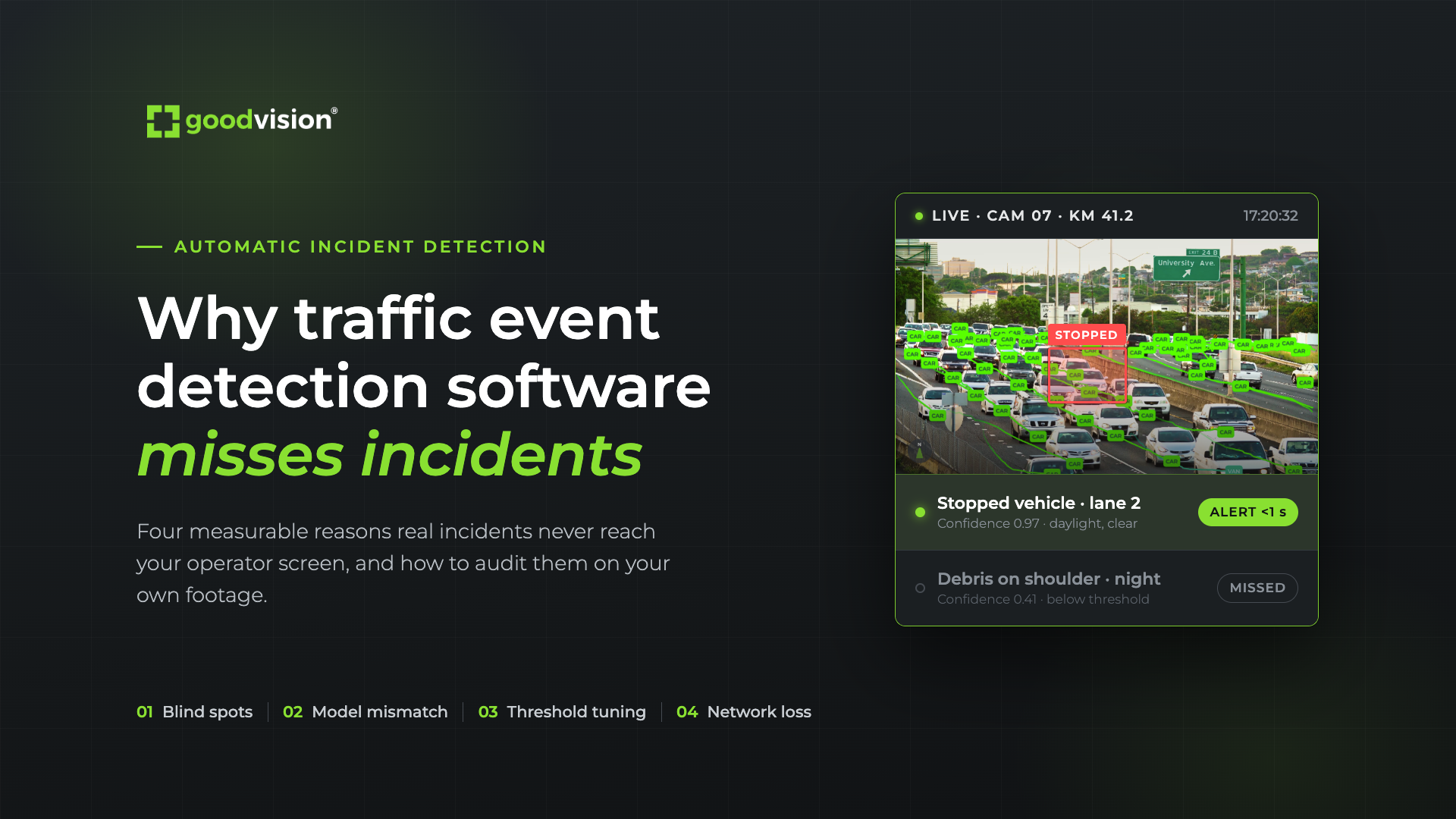
Traffic event detection software misses incidents for four main reasons: camera placement and lighting create blind spots, detection models are trained on traffic patterns that don't match your corridor, alert thresholds are tuned to suppress false alarms at the cost of true ones, and network conditions delay or drop the event before it reaches your operator screen.
If you run a highway TMC, a tunnel, or a bridge network, you've probably had the experience of reviewing footage after an incident and finding your automatic incident detection (AID) system never raised an alert. The vendor's accuracy sheet said one thing. Your operations log says another. That gap is not unusual, and it is measurable if you know where to look.
What Is Traffic Event Detection Software?
Traffic event detection software is a system that analyzes live camera or sensor feeds to identify traffic events, such as stopped vehicles, wrong-way drivers, congestion buildup, or debris in the roadway, and generates an alert without a human watching the screen. It sits between your camera infrastructure and your TMC operators, converting video or sensor data into a structured alert with a location, event type, and timestamp.
Most systems on the market today rely on computer vision models trained on labeled traffic footage, applied either at the camera edge or in a central processing server. The output is only as good as the conditions the model was trained and calibrated for, which is where accuracy problems start.
Why Do Automatic Incident Detection Systems Produce False Negatives?
Automatic incident detection systems produce false negatives, meaning a real incident goes unflagged, when the event pattern falls outside what the detection model was trained to recognize. A stalled vehicle in heavy shadow, a slow-moving breakdown in stop-and-go traffic, or a pedestrian on a shoulder in low light can all look enough like normal background traffic that the model doesn't flag them.
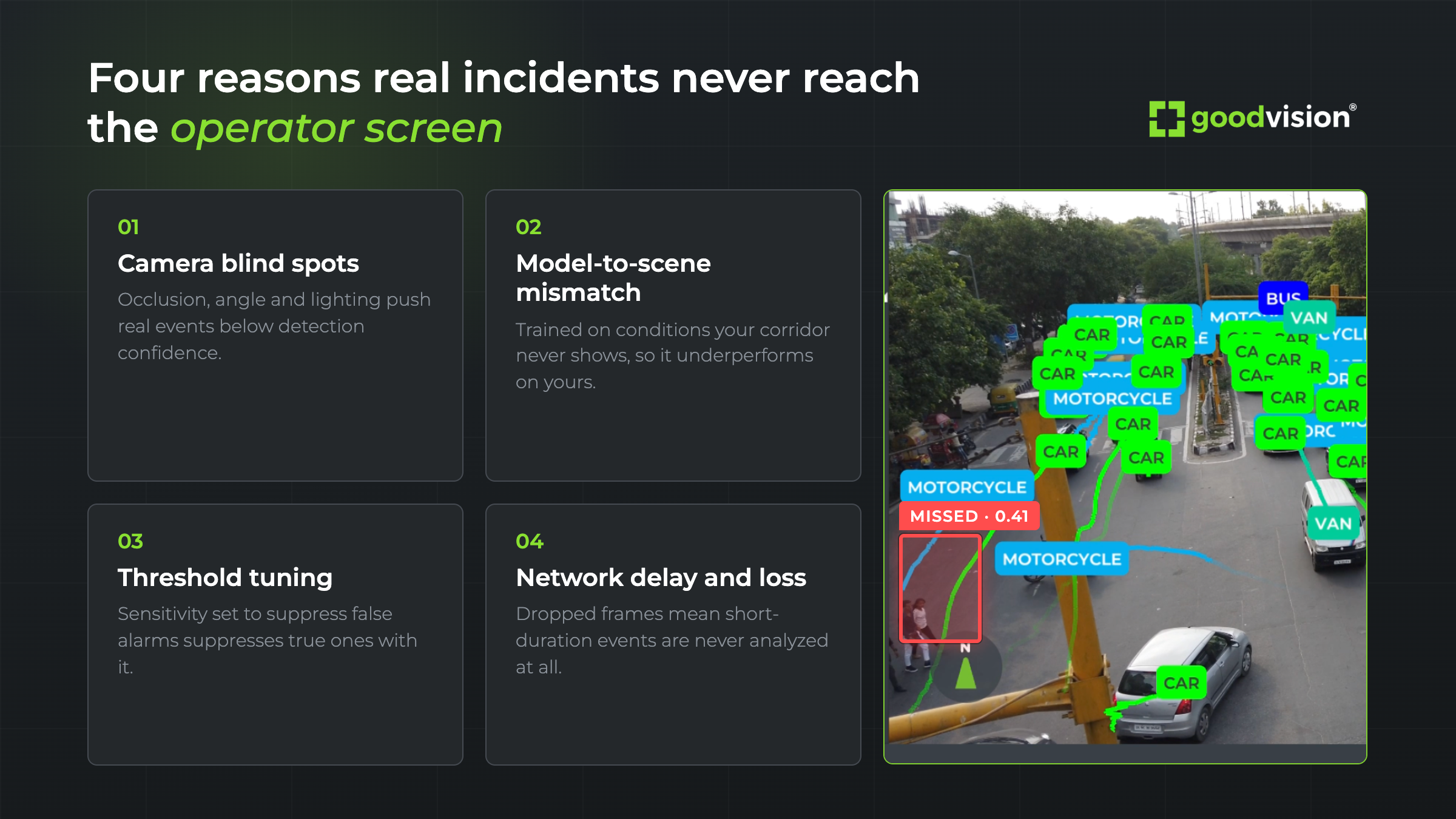
Three conditions drive most false negatives in the field:
- Occlusion and camera angle. A vehicle partially hidden by a truck, a barrier, or a bridge structure often falls below the confidence threshold needed to trigger an alert.
- Model-to-scene mismatch. A model tuned on daytime, dry-pavement footage from one region underperforms on a different climate, lighting profile, or lane geometry it hasn't seen.
- Alert threshold tuning. Vendors calibrate sensitivity to avoid nuisance alerts. Turning that threshold down to catch more real incidents means catching more false alarms too. Every AID system makes this trade-off, and the setting your vendor shipped with may not fit your corridor.
How Do Sensor Performance Issues Affect Incident Detection Accuracy?
Sensor performance issues degrade incident detection accuracy independently of the detection model itself. A camera can have a perfectly good AI model behind it and still miss events because the input feed is compromised before analysis even starts.
Common sensor-level causes include:
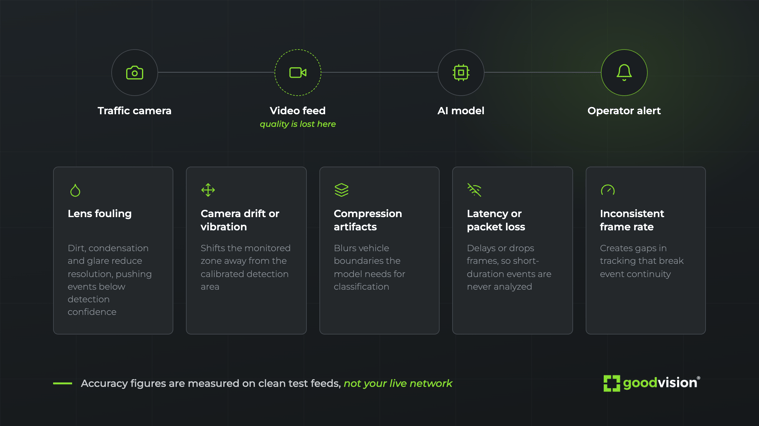
None of these show up in a vendor's published accuracy figure, because that figure is usually measured on clean, well-maintained camera feeds in test conditions. Your live network rarely matches the test bench.
How Should You Evaluate Incident Detection Accuracy on Your Own Network?
You should evaluate incident detection accuracy by running a controlled comparison between your system's alerts and a ground truth log, not by relying on a vendor's published percentage. A vendor figure describes performance under the conditions it was measured, not the conditions on your specific cameras, in your specific weather, at your specific traffic volumes.
A defensible evaluation method:
- Pull a sample of recorded footage from your actual cameras covering a mix of day, night, and weather conditions.
- Manually log every real incident in that footage to build ground truth.
- Run your AID system against the same footage and compare its alerts against the ground truth log.
- Calculate false negative rate (missed real incidents) and false positive rate (nuisance alerts) separately. They trade off against each other, so report both.
- Repeat quarterly, since camera degradation and traffic pattern shifts change performance over time.
The Federal Highway Administration's Traffic Incident Management program frames incident detection performance as a function of the full clearance timeline, not a standalone accuracy score, which is the right lens for a TMC evaluating a live system rather than a lab benchmark.
How Does GoodVision Live Traffic Reduce Missed Incidents?
GoodVision Live Traffic reduces missed incidents by running detection against your camera infrastructure with an alert latency under one second, so operators see events while there is still time to act rather than reviewing them after the fact.
At Attiki Odos, the 70-kilometer highway network around Athens that Attikes Diadromes operated until October 2024 and still maintains today, GoodVision Live Traffic was deployed for real-time monitoring and continuous highway optimization. It gives operators live counts, speeds and vehicle classification by direction, plus the ability to see congestion building at toll plazas and on high-volume sections, according to GoodVision's case study with Attikes Diadromes. That deployment ran on the network’s own cameras, with twelve added at critical locations to capture bi-directional flows. It is the practical lesson for anyone auditing missed events: detection has to be calibrated against the views your network actually has, not against a reference scene.
For more on the operational cost of catching incidents late, see the hidden cost of late incident detection and how real-time AID supports traffic safety programs. If you manage a highway, bridge, or tunnel network, the GoodVision AID solution page and the highways solution overview outline deployment options against existing cameras.
Book a demo at goodvisionlive.com/request-demo/ and run a false negative check against your own footage before you renew or replace your current AID system.