Origin-destination matrices sit at the foundation of almost every serious transport model. They define where trips start, where they end, and how demand distributes across a network. Get the matrix wrong, and the model is wrong from the first run — no matter how carefully everything else is calibrated.
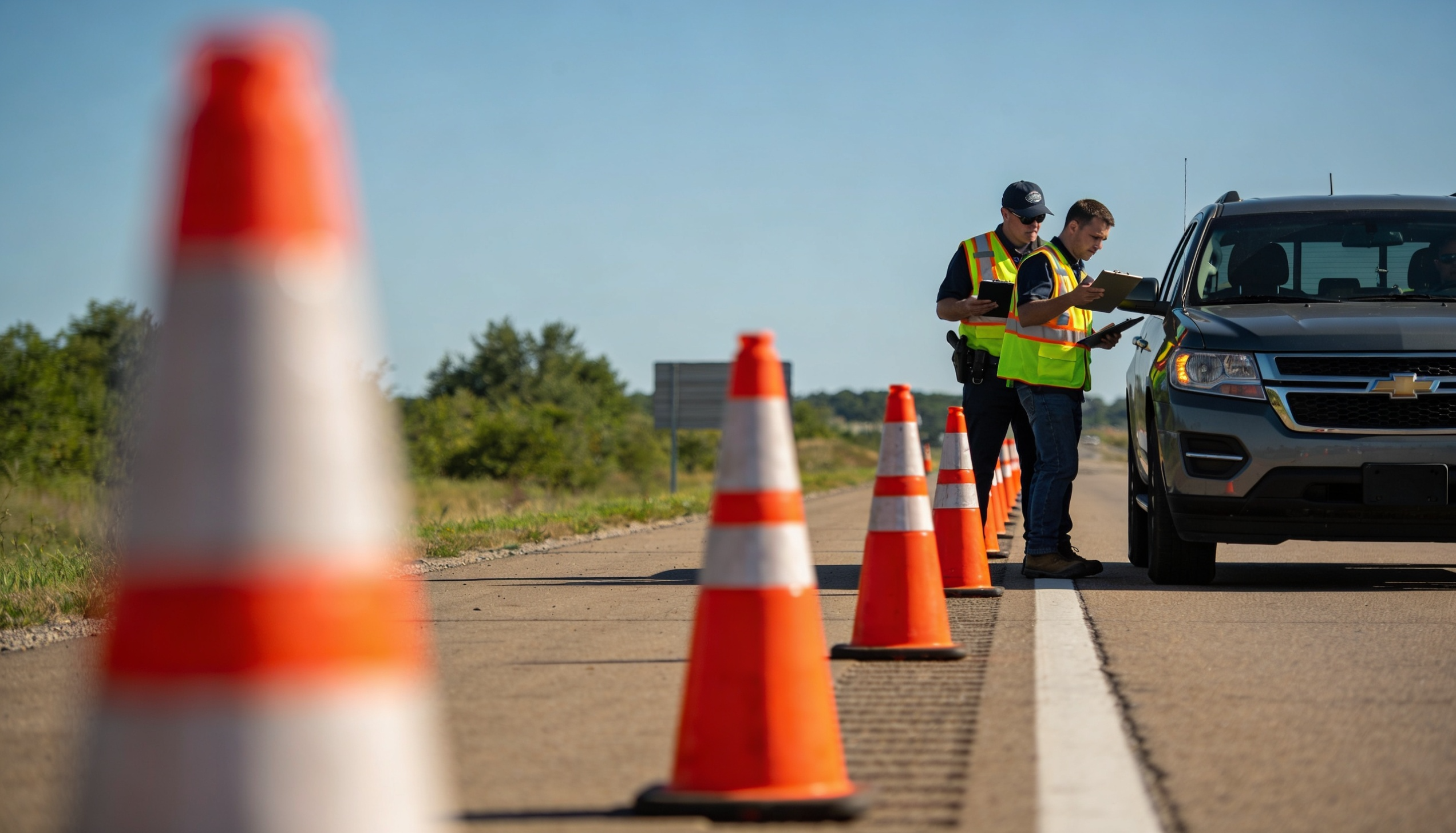
The traditional method for building observed O-D data relies heavily on roadside intercept surveys. A team stops drivers, asks where they came from and where they're going, and collects a few hundred responses over a 2-hour window. That data then gets expanded to represent all-day demand using growth factors, model assumptions, and professional judgment. The result is defensible on paper, but it carries sampling error from start to finish.
The 2-hour window is the core problem. Morning peak captures one travel behavior. School holidays capture another. Seasonal variation, special events, and long-distance through-traffic all fall outside the survey window. What modellers receive is a snapshot presented as a full picture.
Why Intercept Surveys Cap Out at Approximation
A typical roadside intercept survey captures a small fraction of passing vehicles — often 5–10%, depending on site conditions and crew size. The remainder gets imputed. Statistical expansion from a thin sample to full-day demand introduces compounding uncertainty that rarely appears in the final model inputs. The matrix you feed into Vissim or Saturn carries error bars that simply do not show up in the spreadsheet.
The logistics add their own constraints. Survey crews need permits, traffic management plans, risk assessments, and often police coordination. You get one shot at each time period. If weather degrades data quality or crew gaps cause missed vehicles, there is no recovery mechanism. Resurveying is technically possible but expensive, and in practice it almost never happens.
Cost compounds the limitation. A multi-site intercept program across a major junction network runs to significant consultant fees before a single model run has started. For planning studies operating on tight budgets, that expense forces compromises: fewer sites, shorter survey windows, thinner samples.
What Full Trajectory Data Delivers Instead
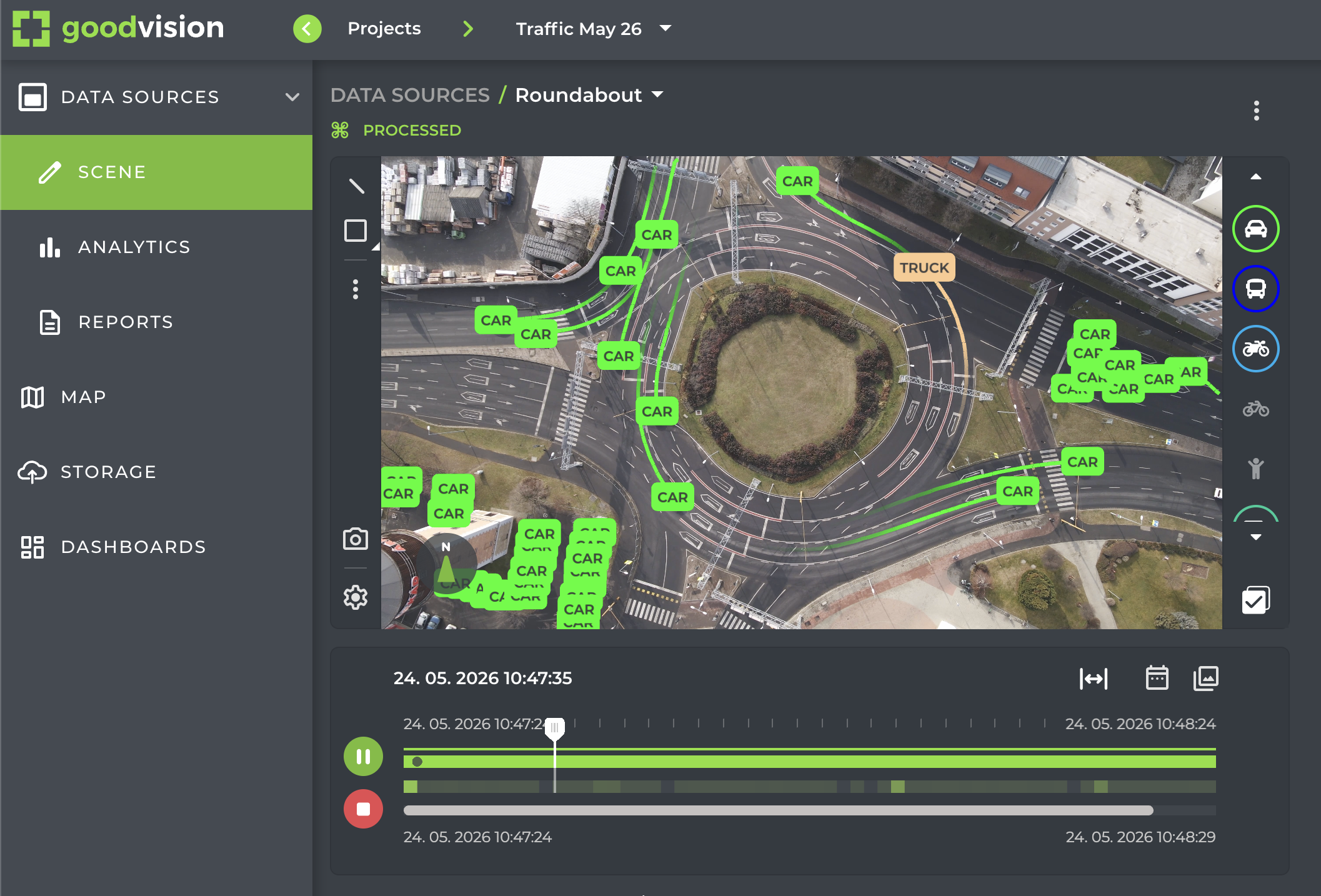
Drone footage captured across a study area gives you something categorically different: complete vehicle trajectories for every object in frame, for the full duration of the flight.
That trajectory data contains the origin and destination of every movement through the observed zone — not a sample of it. You can reconstruct turn movements, route choices, and travel time distributions simultaneously from a single capture. Rather than running three separate survey exercises (turning counts, O-D intercepts, and travel time runs), you deploy one drone and derive all three from the same footage.
The data also supports time-slice analysis. Because every vehicle path is tracked individually, you can generate O-D matrices for any time window: AM peak, inter-peak, PM peak, or custom intervals aligned to your model's demand periods. For transport modellers calibrating microsimulation tools, saturation flows, gap acceptance parameters, and route distribution can all be extracted from the same dataset — a workflow that cuts calibration time dramatically, as covered in detail in this guide on cutting Vissim calibration time with Video Insights.
How GoodVision Processes Drone Footage Into O-D Matrices
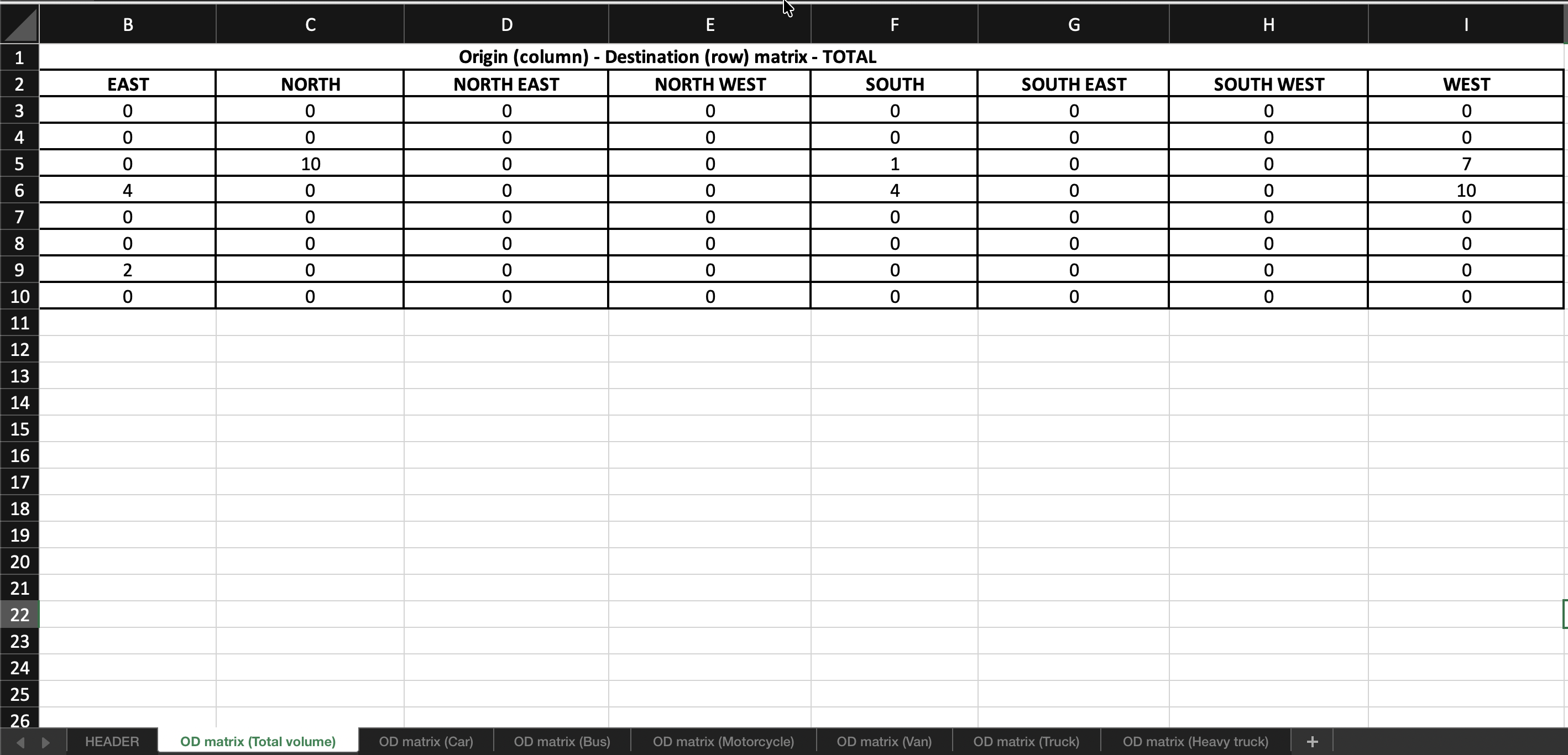
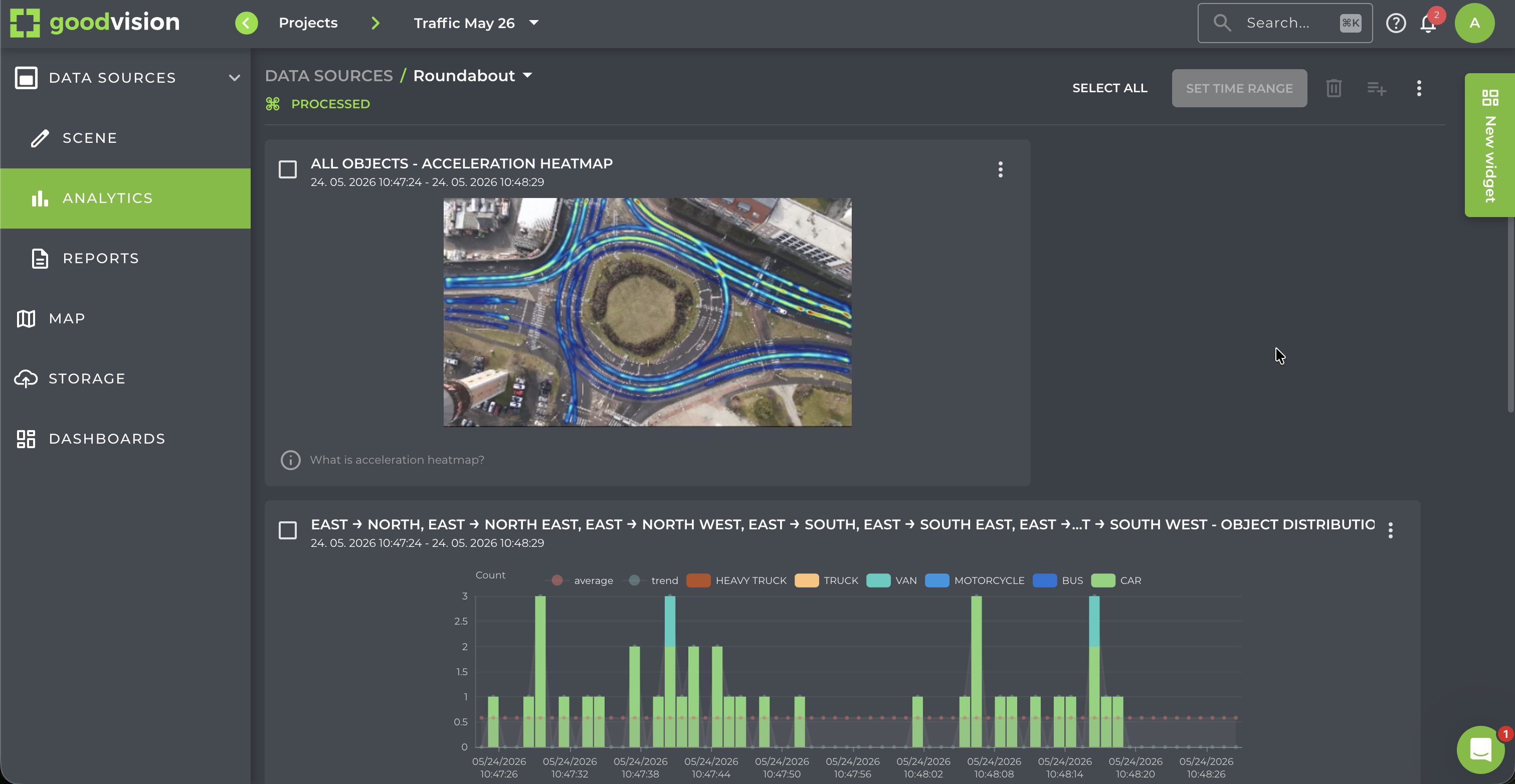
GoodVision Video Insights processes drone footage in the cloud using parallel AI pipelines. Upload a flight's worth of recordings, and the platform returns trajectory data, turn movement counts, vehicle classifications, and a built-in origin-destination matrix report within hours — regardless of total video length.
Accuracy and Vehicle Classification
Accuracy on traffic counts and classifications runs at 95%+, validated against manual counts across multiple geographies and road types. The platform recognizes 8 vehicle classes as standard, including cyclists and pedestrians. For Singapore and APAC deployments, a 10-class scheme is available — currently the only platform offering that classification depth for the region.
Data Footprint and Storage
The data footprint is 1,000x smaller than raw video. You retain the full analytical output without storing hours of full-resolution footage, which matters when project data governance policies limit what you can archive. For teams that do need to retain source recordings, GoodVision Vault handles encrypted cloud storage of the underlying video alongside the processed output.
The traffic modelling solutions page outlines the full range of model inputs the platform supports, including saturation flows, gap acceptance, and classified turning counts alongside O-D.
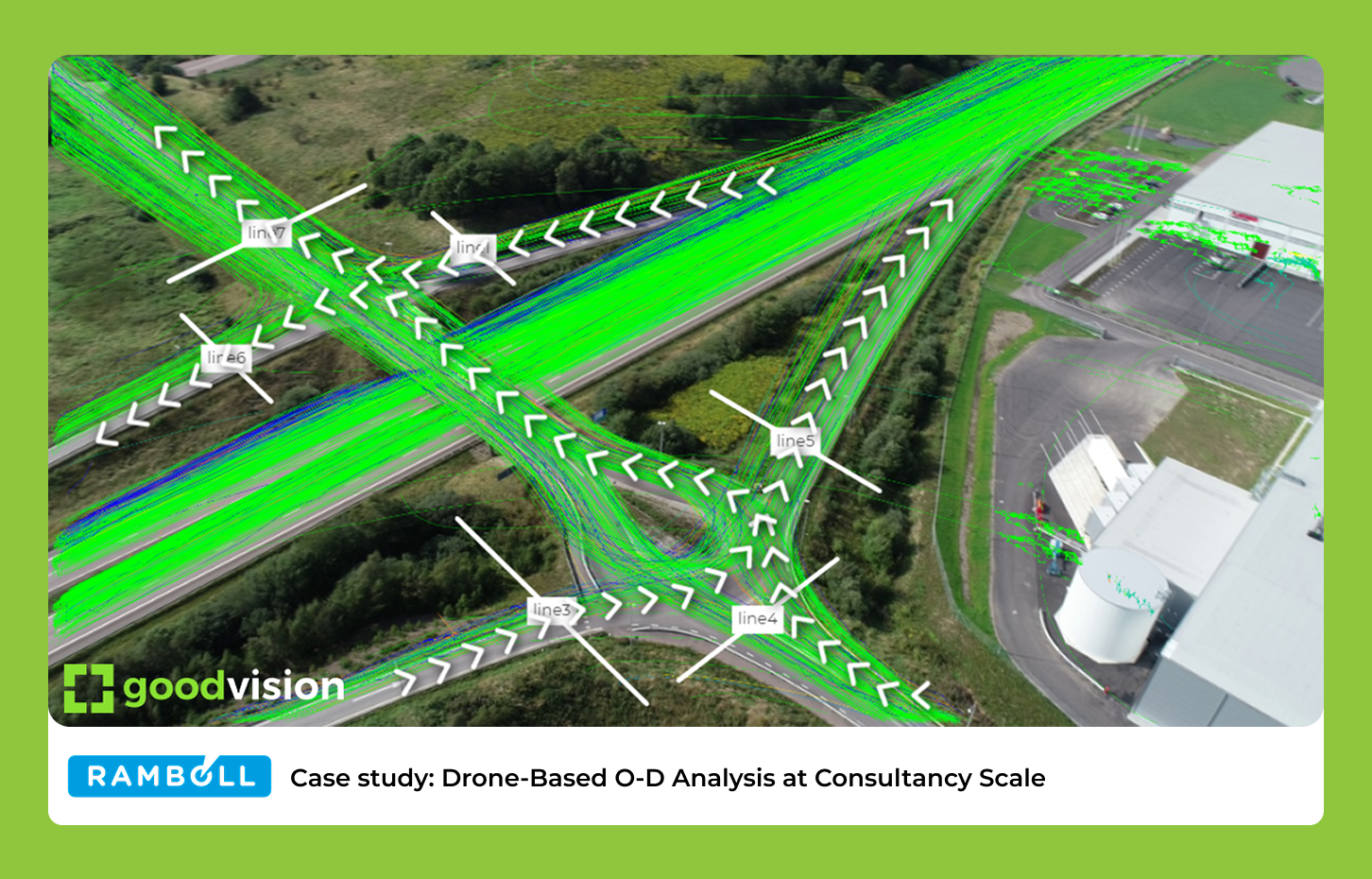
Ramboll: Drone-Based O-D Analysis at Consultancy Scale
Ramboll, one of Europe's largest engineering consultancies, used GoodVision Video Insights to process drone footage for surveys requiring full trajectory and O-D analysis. The Ramboll drone analytics case study documents how the workflow replaced manual counting crews and multi-stage post-processing with a single upload-and-analyze pipeline.
The output fed directly into transport models without the intermediate reclassification and gap-filling steps that manual survey data typically requires. Analysts spent time interpreting results rather than cleaning inputs.
That outcome is consistent with how Mott MacDonald deployed the platform for transit planning in Manila. The volume and complexity of multi-modal traffic in that corridor made traditional intercept surveys unworkable at the required scale. The Mott MacDonald Manila case study details how Video Insights delivered the classified movement data needed to support a major transit infrastructure decision.
The Case for Replacing the Intercept Survey
A 2-hour intercept survey is not without value. For studies where O-D data is secondary to simple volume counts, and where sample expansion uncertainty is tolerable, it remains a practical option.
For studies where the O-D matrix drives the model — corridor assessments, new development traffic impact analysis, strategic network planning — the sample limitation is a structural constraint on what the model can tell you. Expanding 200 stopped-driver responses into a full-day demand matrix requires assumptions that no amount of professional judgment can fully eliminate.
Drone footage processed through Video Insights removes that constraint. You get complete observed trajectories, not inferred ones. The matrix you submit to a client or regulator reflects what vehicles actually did, not a statistical best guess about what they might have done. And the processing cost is a fraction of a full intercept survey program.
Book a demo at goodvisionlive.com/request-demo/ and see how Video Insights generates O-D matrices from your drone or fixed-camera footage within hours of upload.