Collecting the data that feeds a traffic model is often the slowest, most expensive part of the entire modeling exercise. You can build a Vissim network in a week. Getting the calibration data to make it credible takes just as long, costs a significant share of the project budget, and still depends on field teams counting vehicles by hand.
That ratio is broken. And for the transport modelers and infrastructure consultants who have to defend their outputs to clients, planning committees, and regulators, it creates a real problem: the data underpinning your model is only as good as the collection method. Traditional methods leave too much room for error, and the audit trail is thin.
Video analytics changes that calculation. When you extract calibration inputs directly from processed footage, you get more data, faster, at lower cost, and with a source record that traces every parameter back to the original video. This post breaks down why that matters and how it works in practice.
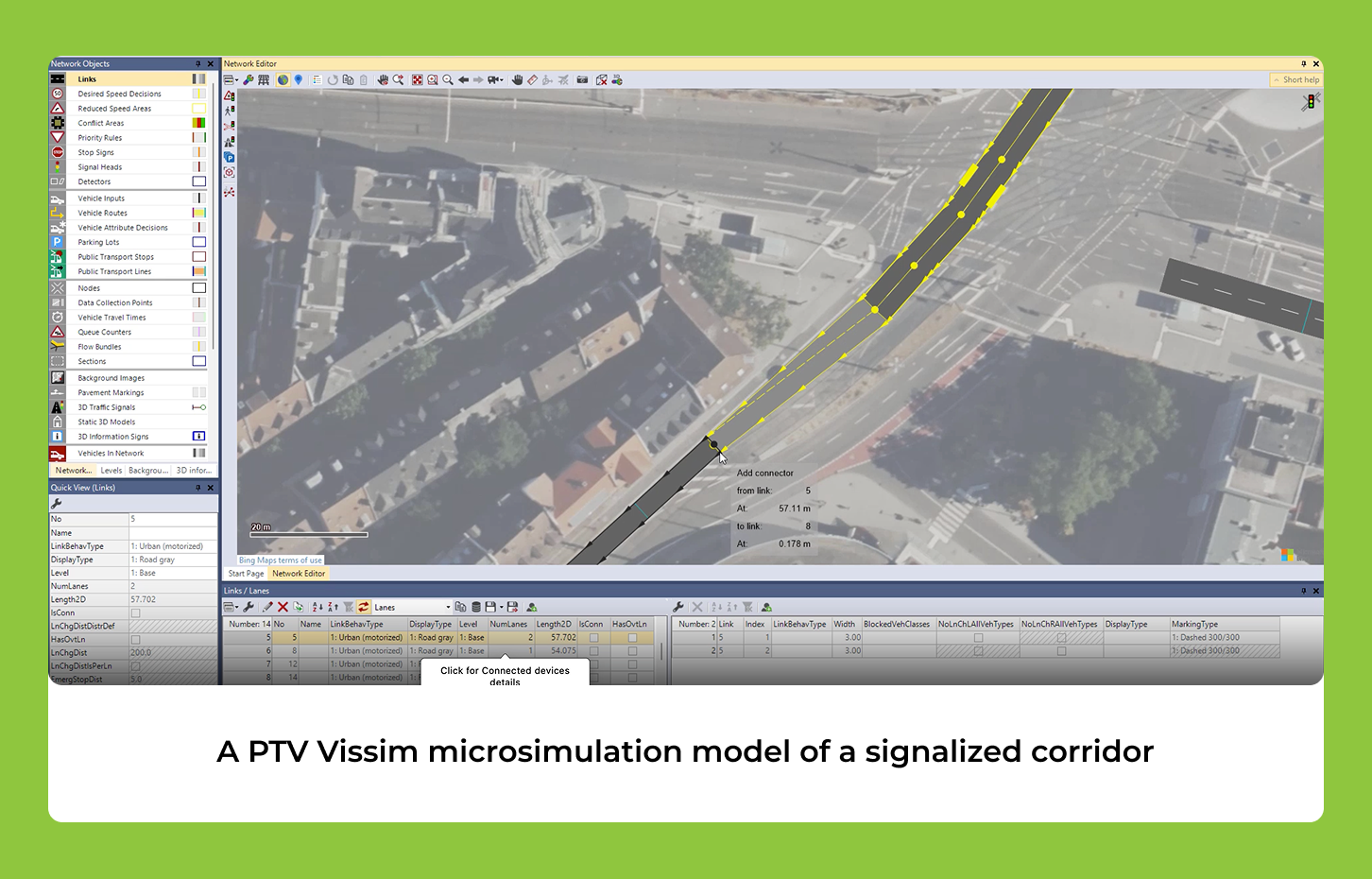
What Traffic Model Calibration Actually Requires
A microsimulation calibration (Vissim, TRANSYT, Linsig) needs specific measured inputs to replicate observed behavior. The standard list includes:
- Turning movement counts by vehicle class and time period
- Saturation flows at signalized intersections
- Gap acceptance parameters for priority junctions and roundabouts
- Origin-destination matrices for corridor or area-wide models
- Vehicle classification breakdowns (cars, HGVs, motorcycles, cyclists, buses)
- Speed profiles and headway distributions
Each of these historically required a separate data collection effort: manual counts during peak periods, pneumatic tube surveys for classification and speed, specialist intercept surveys for O-D, and hours of manual video review to estimate saturation flows or gap acceptance.
The more inputs you need, the more survey trips you need. A two-junction model for a planning application might require four or five site visits. A corridor model might need fifteen. That logistics overhead accumulates fast and compresses every other stage of the project.
Why Traditional Collection Creates Problems for Defensible Outputs
The core issue is not just cost. It is the defensibility of what you produce.
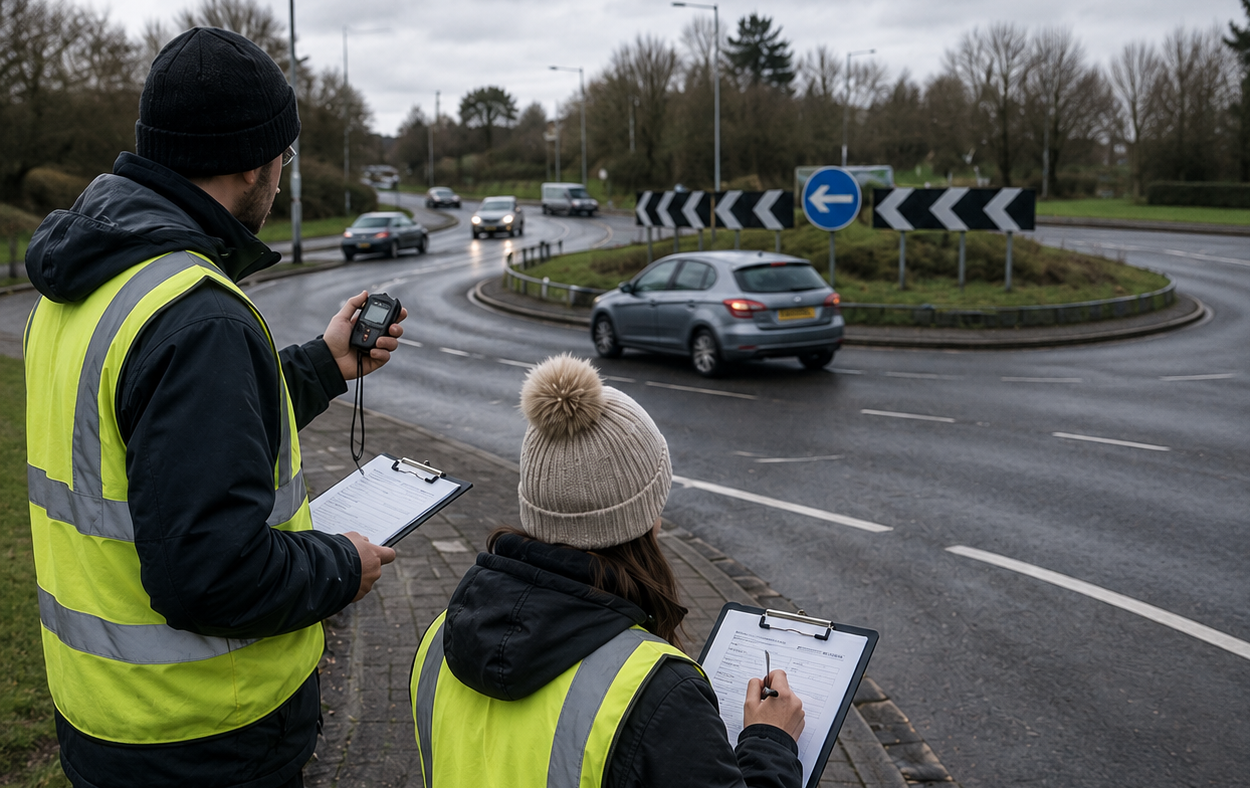
Manual counts done by field crews have known limitations. Counter fatigue after two or three hours affects accuracy. Weather conditions affect classifier visibility. A poorly positioned observer misses cyclists on the footway or motorcycles filtering between lanes. These are not hypothetical problems. They are the reason most transport modelers build in generous uncertainty ranges and hedge their sensitivity tests accordingly.
Road tubes capture volume and rough classification, but they miss turning movements entirely, cannot distinguish a two-axle truck from a bus, and produce no usable data on gap acceptance or saturation flow. If a client or planning inspector asks how you derived your saturation flow at a give-way, "extrapolated from HCM defaults" is a weaker answer than "measured directly from 90 minutes of processed junction footage."
Manual video review fixes some of these problems but creates new ones. Reviewing and coding four hours of footage from a single junction can take a trained analyst 12 to 16 hours. Across a multi-junction model, those analyst hours multiply quickly. The output is also difficult to audit. If a peer reviewer wants to check how you classified an ambiguous vehicle or defined your measurement window for saturation flow, the answer is often buried in a spreadsheet with no traceable link back to the source footage.
Traditional methods also struggle with emerging vehicle types. PCU-based models that treat cyclists as 0.2 passenger car units underestimate their impact at saturated junctions. E-scooters barely register in most existing classification schemes. For urban planners modeling active travel scenarios, that data gap has real consequences. Rethinking saturation flow for bicycles and e-scooters is increasingly not optional.
The Federal Highway Administration's Traffic Analysis Tools guidance is explicit that model credibility depends on locally calibrated inputs rather than default values. That expectation is raising the bar for what constitutes an acceptable calibration data source.
How Video Analytics Produces More Calibration Data, Faster
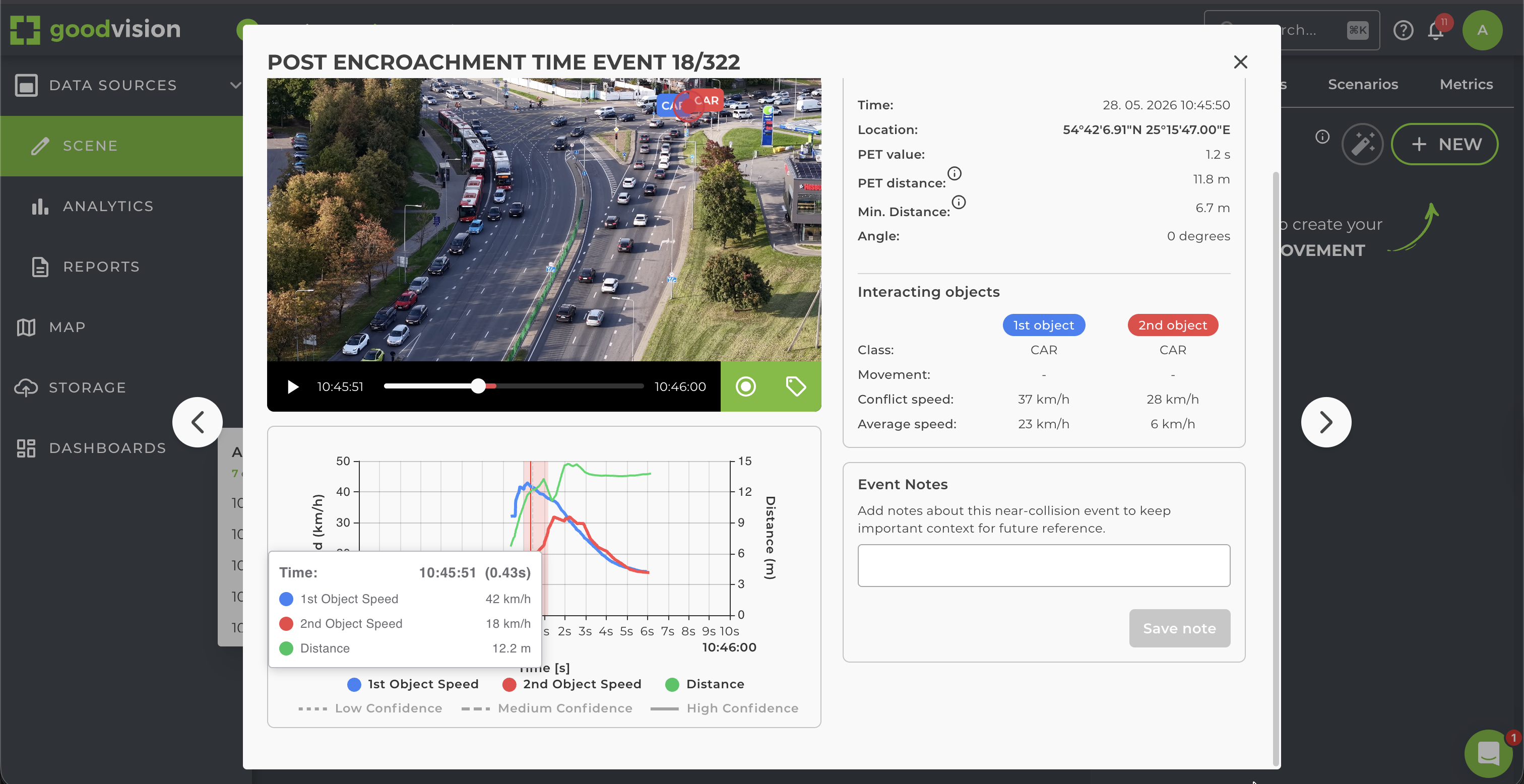
GoodVision Video Insights processes footage you already have or can collect in a single survey deployment. The AI extracts turning movement counts, vehicle classifications, speed profiles, headways, and full trajectory data directly from the video, without manual annotation.
For saturation flows, the platform automates what would otherwise be hours of frame-by-frame review. You define the stop line, set the green phase window, and the system measures discharge headways across the queue. The saturation flow calculation is documented and repeatable. If a reviewer challenges your methodology, you can show them the exact footage interval, the vehicle list, and the headway measurements in the same place.
For gap acceptance, the same principle applies. GoodVision's gap acceptance workflow extracts accepted and rejected gaps from priority junction footage, giving you the empirical distribution your model needs rather than a design manual default.
O-D matrices from drone footage are a particularly strong use case. Ramboll used GoodVision to process drone video for origin-destination data in a format ready for direct import into their transport models. The Ramboll drone analytics case study shows how aerial coverage removes the site access and camera angle constraints that make junction-level O-D surveys difficult with ground-mounted cameras.
IDOM, a global infrastructure consultancy, used GoodVision for transport planning work in Warsaw and described it as delivering results their team would never have achieved through manual counting. The platform processed footage across multiple sites in parallel, compressing a multi-week data collection program into days.
The accuracy figures support the approach. GoodVision achieves 95%+ on turning movement counts and classifications, validated against manual counts. For modelers who need to demonstrate that calibration inputs are robust, that is a number you can put in a technical report and defend under scrutiny.
Processing happens within hours of upload, regardless of footage volume. Parallel cloud processing means a four-camera, eight-hour survey does not take proportionally longer than a two-hour single-camera clip. A detailed breakdown of that workflow is covered in how to cut traffic model calibration time, including a direct comparison of the manual versus automated path through a Vissim calibration.
For consultancies managing multiple concurrent projects, the credit-based pricing model removes subscription overhead. You pay for what you process. On a project that needs saturation flow and gap acceptance data from six junctions, the cost compares favorably to a field crew deployment for the same scope, with more detailed output.
The defensibility argument comes down to this: when a client, a planning inspector, or a peer reviewer challenges your calibration, you need to show your working. Video-derived data gives you an unambiguous audit trail. The footage is the source. Every extracted parameter traces directly back to it.
Book a demo at goodvisionlive.com/request-demo/ to see how GoodVision Video Insights handles your specific calibration requirements on footage you already have.