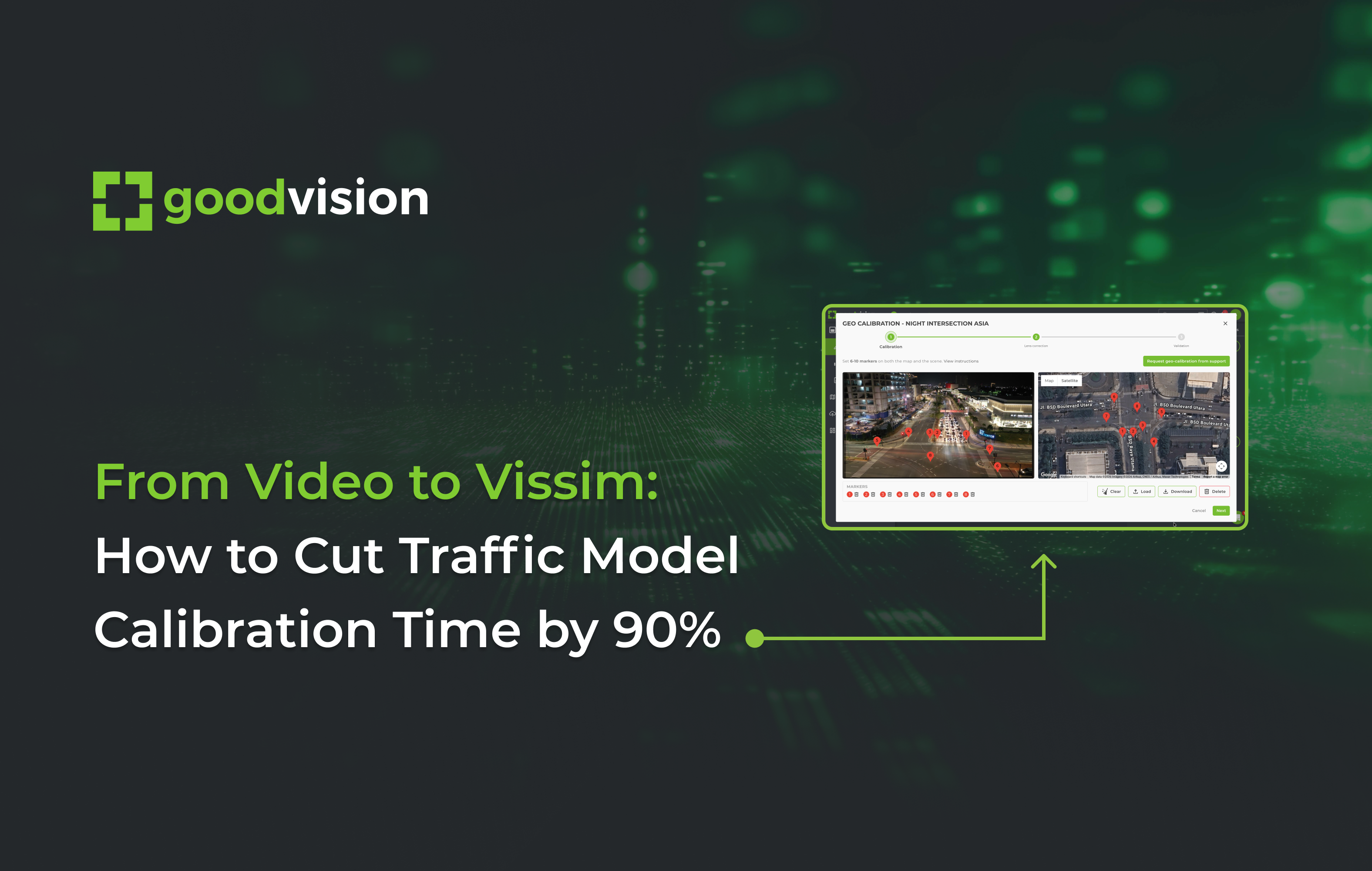
The most time-consuming part of building a microsimulation model isn't the modelling itself. It's everything that comes before you open Vissim. Turning movement counts broken down by vehicle class. Saturation flows at signalised junctions. Origin-destination matrices. Gap acceptance parameters at priority junctions and roundabouts. Gathering all of it through conventional survey methods can consume weeks — and by the time the data lands in your inbox, it's already threatening the project timeline.
For transport modellers at consultancies and planning agencies, this is a structural problem rather than an occasional inconvenience. Clients expect defensible, calibrated outputs. Funding decisions, planning approvals, and infrastructure investment cases rest on the accuracy of what the model says. But the data collection process — manual observers, road tube deployments, analyst hours stitching spreadsheets — hasn't kept pace with the complexity of modern urban networks or the schedule pressures of competitive project delivery.
The result is that modellers regularly work with incomplete datasets, outdated turning counts, or proxy values substituted for real measurements. That's not a skills problem. It's a data pipeline problem.
What Vissim Actually Needs and Why Traditional Methods Struggle to Deliver It
A well-calibrated microsimulation model requires several categories of input data, each traditionally collected through a separate survey type: classified TMCs for junction performance, headway studies for saturation flows, number plate matching or loop detector data for OD estimation, and purpose-built gap acceptance studies where give-way or roundabout junctions are involved.
The coordination overhead of running these surveys in parallel is significant. So is the analytical effort required to reconcile them into a coherent dataset. Surveys conducted on different days, by different teams, in different weather conditions introduce inconsistencies that propagate directly into model calibration — and from there into the transport appraisal your client is relying on.
Accuracy compounds the problem. Manual observers miss vehicles during peak saturation. Road tubes misclassify motorcycles and light goods vehicles. Headway studies can be distorted by an atypical incident on the survey day. None of these errors are individually catastrophic, but together they create calibration noise that requires additional iteration to resolve — iteration that costs time and budget the project rarely has.
The Transportation Research Board consistently identifies data quality and consistency as primary constraints on microsimulation fidelity. The issue isn't just volume of data — it's the coherence of the dataset across multiple parameters simultaneously.
A Single Source for Every Calibration Parameter
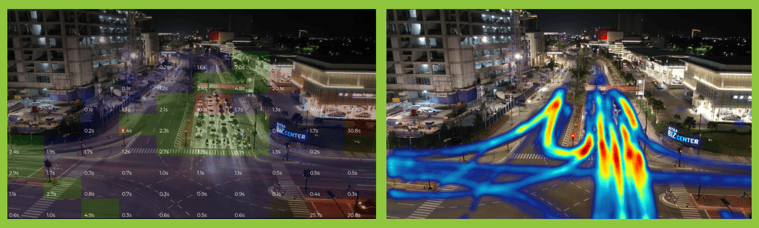
Video-based AI analytics changes the equation by collapsing multiple survey types into a single deployment. One camera. One processing run. Every parameter your model needs — extracted from the same traffic stream, under the same conditions, by the same analytical engine.
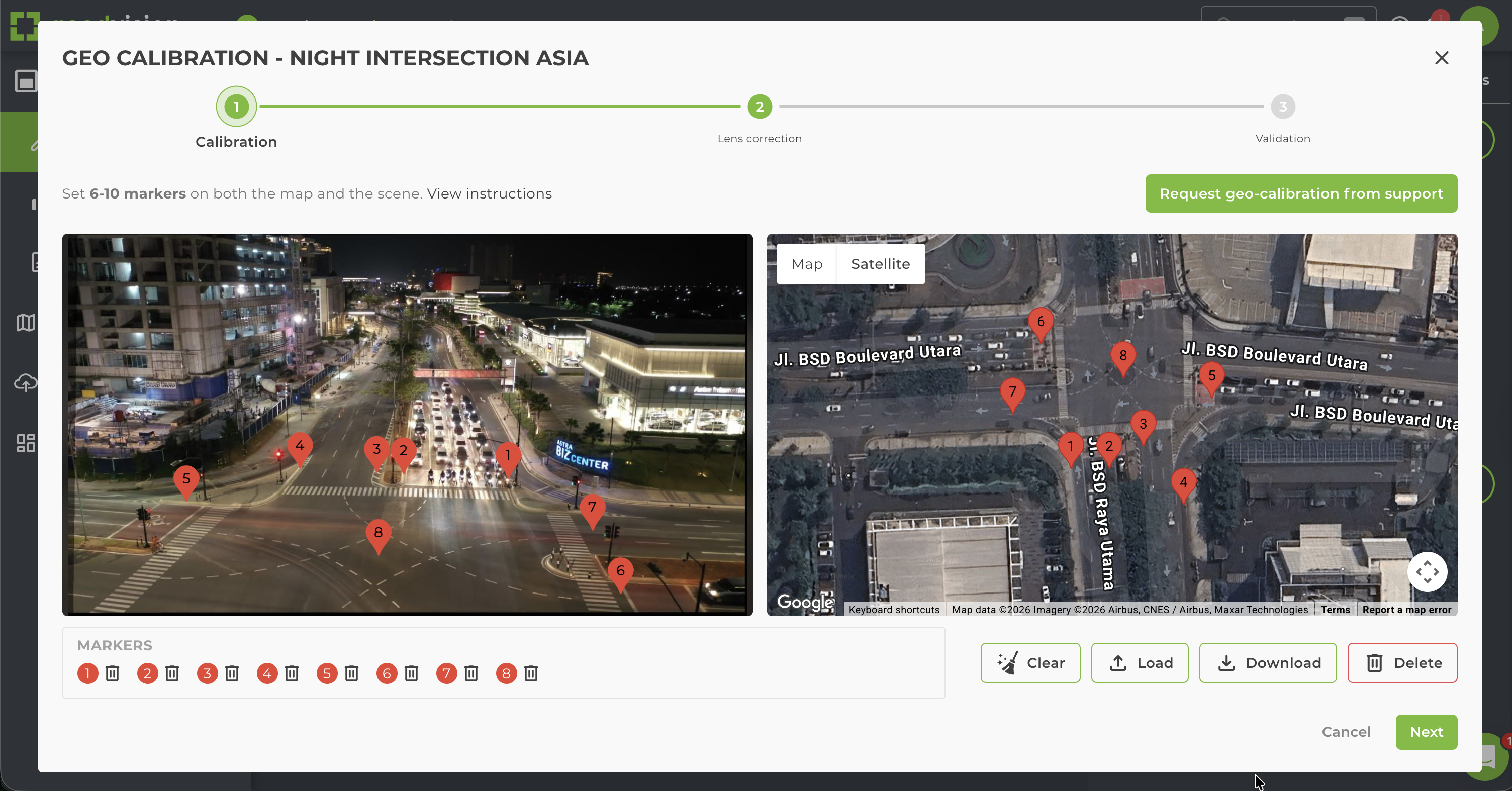
GoodVision Video Insights fits perfectly into this workflow. Upload footage from any camera — fixed CCTV, temporary survey cameras, or drone — and within 1–2 hours the platform returns a complete dataset for calibration: classified turning movement counts across 8 vehicle classes, saturation flows calculated automatically at signalised junctions, origin-destination matrices, and gap acceptance parameters for priority junctions and roundabouts.
That 1–2 hour processing window is consistent regardless of video length, because the platform uses parallel cloud processing rather than sequential analysis. A four-hour peak period survey returns at the same speed as a 30-minute clip. Accuracy sits above 95% for counts and classifications — reliable enough for direct use in model calibration without the manual QA overhead that conventional survey data typically demands.
Outputs are exported in formats that feed directly into Vissim and other microsimulation tools, removing the spreadsheet manipulation that typically adds several analyst hours to every calibration project. For a detailed breakdown of what this means in practice, the guide to cutting Vissim calibration time with GoodVision covers the full workflow step by step. The traffic modelling solutions page outlines every parameter the platform supports — useful reference when you're assessing coverage against a specific modelling brief.
Why Data Coherence Matters as Much as Speed
Faster collection only helps if the data is accurate. The argument for AI video analytics isn't speed alone — it's the structural advantage of a single-source dataset.
When every calibration parameter comes from the same video footage, processed by the same algorithm, you eliminate the cross-survey inconsistencies that create calibration noise. Your saturation flow data and your turning movement counts reflect exactly the same traffic conditions. Your OD matrix is derived from the same observed vehicle trajectories that inform your junction performance analysis. That coherence is difficult to achieve when you're reconciling data from multiple survey types conducted at different times by different teams.
This is why modellers who move to video analytics typically find that calibration iterations reduce alongside data collection time. The data is not just faster to produce — it's more internally consistent, which means the model converges more cleanly.
The Repeating Pattern
The pattern repeats consistently across other major consultancies. Ramboll have used GoodVision for drone-based analytics on survey assignments where ground-level methods can't match the coverage. IDOM applied the platform on a Warsaw transport planning project. CzechConsult have moved to full automation of their traffic data collection workflow. In each case, the driver was the same: more complete data, faster, at a cost that made project economics work.
From Weeks to Hours
The cumulative effect is a compression of the entire pre-modelling workflow. What previously required a week of survey coordination, several days of processing, and multiple rounds of analyst work in model calibration can be handled in a single day — not by cutting corners on data quality, but by removing the inefficiencies built into a manual, multi-source collection process.
The 90% time reduction on calibration preparation isn't a theoretical ceiling. It reflects what happens when you replace a fragmented survey pipeline with a coherent, automated one: fewer data gaps, fewer reconciliation steps, fewer calibration iterations, and a faster path from raw video to a model your client can rely on.
If you're preparing for a modelling project and want to see exactly what GoodVision Video Insights produces for your specific junction types and vehicle mix, request a demo at goodvisionlive.com/request-demo/ — the team can walk through your brief and show you the outputs before you commit.