---
title: How Transport Authorities Use Vision AI Instead of Manual Audits
description: How transport authorities use video AI to automate conflict studies, detect near-misses in real time, and replace costly manual safety audits at network scale.
image: https://blog.goodvisionlive.com/hubfs/How%20Transport%20Authorities%20Use%20Vision%20AI.png
---
###### Stay in touch
### Subscribe to Newsletter
Get latest updates and news about GoodVision directly to your inbox.
[](https://goodvisionlive.com/)
[](https://goodvisionlive.com/)
- [Free demo](https://goodvision.typeform.com/freetrial25?utm_source=gv-blog&utm_medium=menu)
- [Case studies](https://casestudies.goodvisionlive.com)
- [Blog](https://blog.goodvisionlive.com)
- [Return to homepage](https://goodvisionlive.com/)
[Contact us](https://goodvisionlive.com/contacts/)
[](https://goodvisionlive.com/)
- [Case studies](https://casestudies.goodvisionlive.com)
- [Blog](https://blog.goodvisionlive.com)
- [Return to homepage](https://goodvisionlive.com/)
- [Contact us](https://goodvisionlive.com/contacts)
[](https://goodvisionlive.com/)
[](https://goodvisionlive.com/)
- [Solutions](https://goodvisionlive.com/solutions/)
- [Products](https://goodvisionlive.com/products/)
- [Video Insights Platform](https://goodvisionlive.com/goodvision-video-insights/)
- [GoodVision Live Traffic](https://goodvisionlive.com/goodvision-live-traffic/)
- Partners
- [Global Sales Partners](https://goodvisionlive.com/partners/)
- [Technology Partners](https://goodvisionlive.com/technology-partners/)
- [Academy Program](https://goodvisionlive.com/goodvision-academy/)
- Resources
- [Case Studies](https://casestudies.goodvisionlive.com/)
- [Help Portal](https://goodvisionlive.com/support/)
- [Webinars](https://goodvisionlive.com/webinars/)
- [Blog](https://blog.goodvisionlive.com/)
- [Company](https://goodvisionlive.com/about-goodvision/)
- [About GoodVision](https://goodvisionlive.com/about-goodvision/)
- [Our Vision](https://goodvisionlive.com/our-vision/)
- [Careers](https://goodvisionlive.com/careers/)
- [Press kit](https://goodvisionlive.com/press-kit/)
- [Contact us](https://goodvisionlive.com/contacts/)
[Contact us](https://goodvisionlive.com/contacts/)
[](https://goodvisionlive.com/)
- [Solutions](https://goodvisionlive.com/solutions/)
- [Products](https://goodvisionlive.com/products/)
- [Video Insights Platform](https://goodvisionlive.com/goodvision-video-insights/)
- [GoodVision Live Traffic](https://goodvisionlive.com/goodvision-live-traffic/)
- Partners
- [Global Sales Partners](https://goodvisionlive.com/partners/)
- [Technology Partners](https://goodvisionlive.com/technology-partners/)
- [Academy Program](https://goodvisionlive.com/goodvision-academy/)
- Resources
- [Case Studies](https://casestudies.goodvisionlive.com/)
- [Help Portal](https://goodvisionlive.com/support/)
- [Webinars](https://goodvisionlive.com/webinars/)
- [Blog](https://blog.goodvisionlive.com/)
- [Company](https://goodvisionlive.com/about-goodvision/)
- [About GoodVision](https://goodvisionlive.com/about-goodvision/)
- [Our Vision](https://goodvisionlive.com/our-vision/)
- [Careers](https://goodvisionlive.com/careers/)
- [Press kit](https://goodvisionlive.com/press-kit/)
- [Contact us](https://goodvisionlive.com/contacts/)

# How Transport Authorities Use Vision AI Instead of Manual Audits
May 21, 2026, 5:07:55 PM
Every road fatality is preceded by dozens of near-misses that go unrecorded. That's not conjecture — it's an established pattern in road safety research, and it points to a structural problem that traffic operations managers face every day. The challenge isn't a lack of cameras. It's the gap between footage recorded and footage analysed. Manual conflict studies, the traditional backbone of proactive road safety, are too slow, too costly, and too resource-intensive to operate at the scale that Vision Zero commitments demand.
The result is a system that is structurally reactive. Interventions happen after injuries and fatalities, not before. Traffic operations managers know this problem intimately: CCTV archives fill up, field observers are expensive, and the forensic review of even a single high-risk intersection can take days of skilled analyst time. Multiply that across a city's network, and meaningful conflict analysis becomes practically impossible within any normal operational budget.
Video AI changes that equation — not by replacing engineering judgement, but by solving the scale problem that has always made proactive safety monitoring unworkable.
## Why Traditional Conflict Studies Cannot Keep Up
Road safety conflict studies rely on Post Encroachment Time (PET) and Time to Collision (TTC) — metrics that quantify how close two road users came to colliding without actually doing so. Both are proven, defensible measures used by safety engineers worldwide. The problem is how they have historically been collected.
The conventional approach involves trained observers watching recorded footage, manually logging events, timestamping interactions, and calculating metrics frame by frame. A thorough study of a single approach at a busy intersection might require 40–60 hours of analyst time. For a transport authority managing hundreds of sites, that is not a methodology — it is a bottleneck.
As [the limitations of near-miss detection as a safety metric](https://blog.goodvisionlive.com/near-miss-detection-road-safety-metric-cities-getting-wrong) have become better understood by practitioners, the demand for higher-volume conflict data has grown. But the tools have not scaled to match. Manual review processes that made sense for one-off safety audits are failing city authorities that need continuous, network-wide insight.
## 
## The Data Sits in the Cameras. The Problem Is Getting It Out.
Most urban traffic management centres already operate dense camera networks. In a mature deployment, hundreds of feeds run continuously — at signalised junctions, pedestrian crossings, school zones, highway on-ramps, and bus corridors. The raw data needed for serious conflict analysis exists. It is not being used at scale.
The FHWA [Office of Safety](https://safety.fhwa.dot.gov/) and equivalent bodies in Europe consistently emphasise the value of surrogate safety measures — conflict-based metrics that allow authorities to identify high-risk locations before crashes occur. The infrastructure to collect those measures continuously has remained out of reach for most operators.
This is the operational gap: authorities are recording the evidence, but cannot process it fast enough to act on it. A near-miss event captured on camera at 09:15 on a Tuesday should not surface in a monthly report. It should trigger a response the same morning. For [real-time traffic safety](https://blog.goodvisionlive.com/real-time-aid-traffic-safety) interventions to be meaningful, the latency between event and alert has to collapse from hours or days to seconds.
## What Automated Near-Miss Detection Actually Delivers
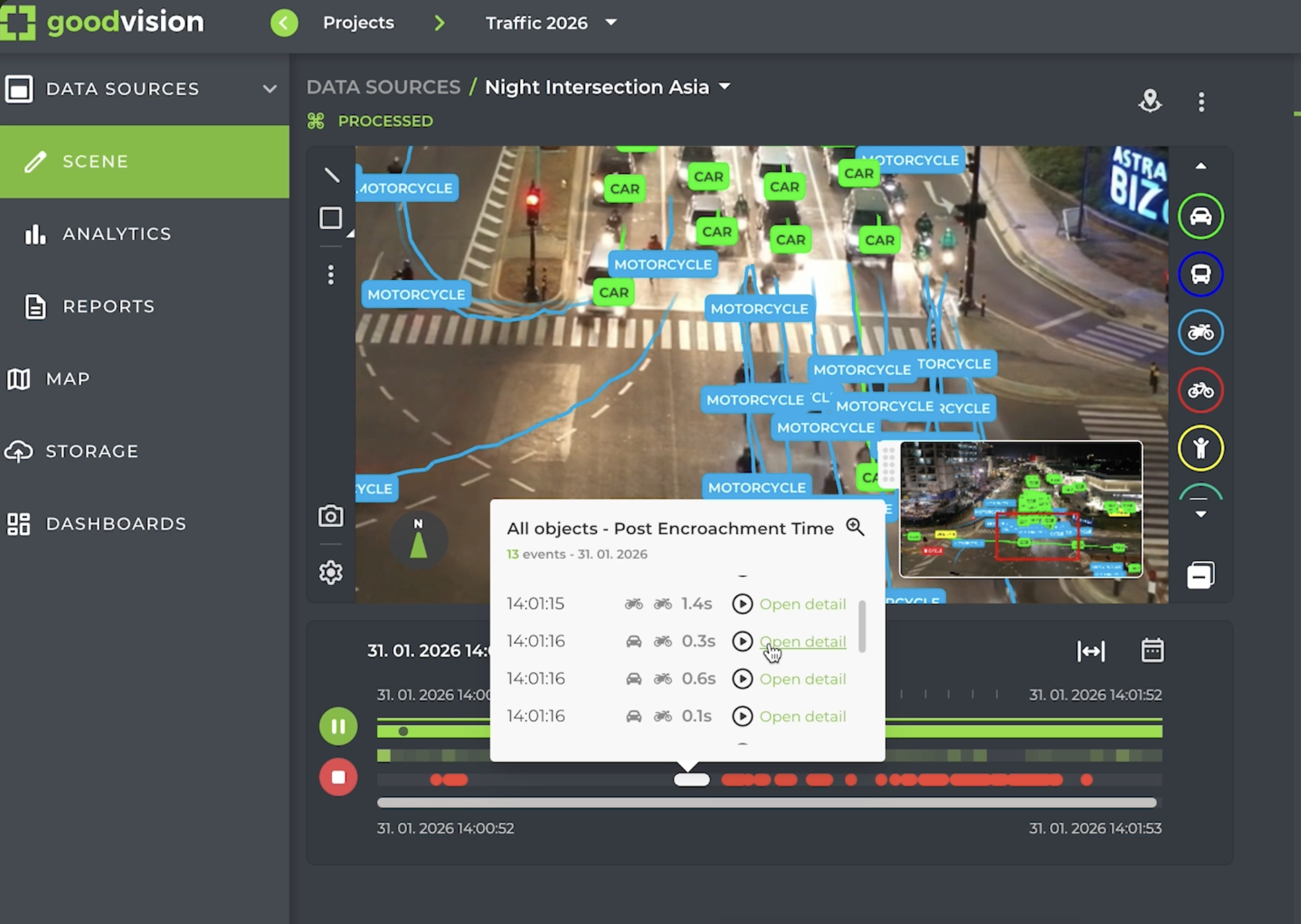
Video AI platforms built for traffic safety process trajectory data for every road user in frame — vehicle, pedestrian, cyclist — and compute conflict metrics continuously against configurable PET and TTC thresholds. When a trajectory pair crosses the threshold, it is flagged immediately. No observer required. No manual review queue.
The operational impact is significant. Automated approaches are [90% faster than traditional near-miss detection methods](https://goodvisionlive.com/solutions/near-collision-detection) and deliver an 80% reduction in cost compared to conventional forensic road safety analysis. For a transport authority running continuous monitoring across a network of camera sites, that is the difference between an annual safety audit and a live safety intelligence system.
Automated conflict detection also enables analysis that was not previously feasible: multi-site comparisons across a city network, seasonal trend analysis, and before-and-after studies following signal timing changes or geometric modifications. The data volume required for statistically robust conclusions is now achievable without proportional increases in analyst headcount.
## 
## How GoodVision's Road Safety Analytics Works in Practice
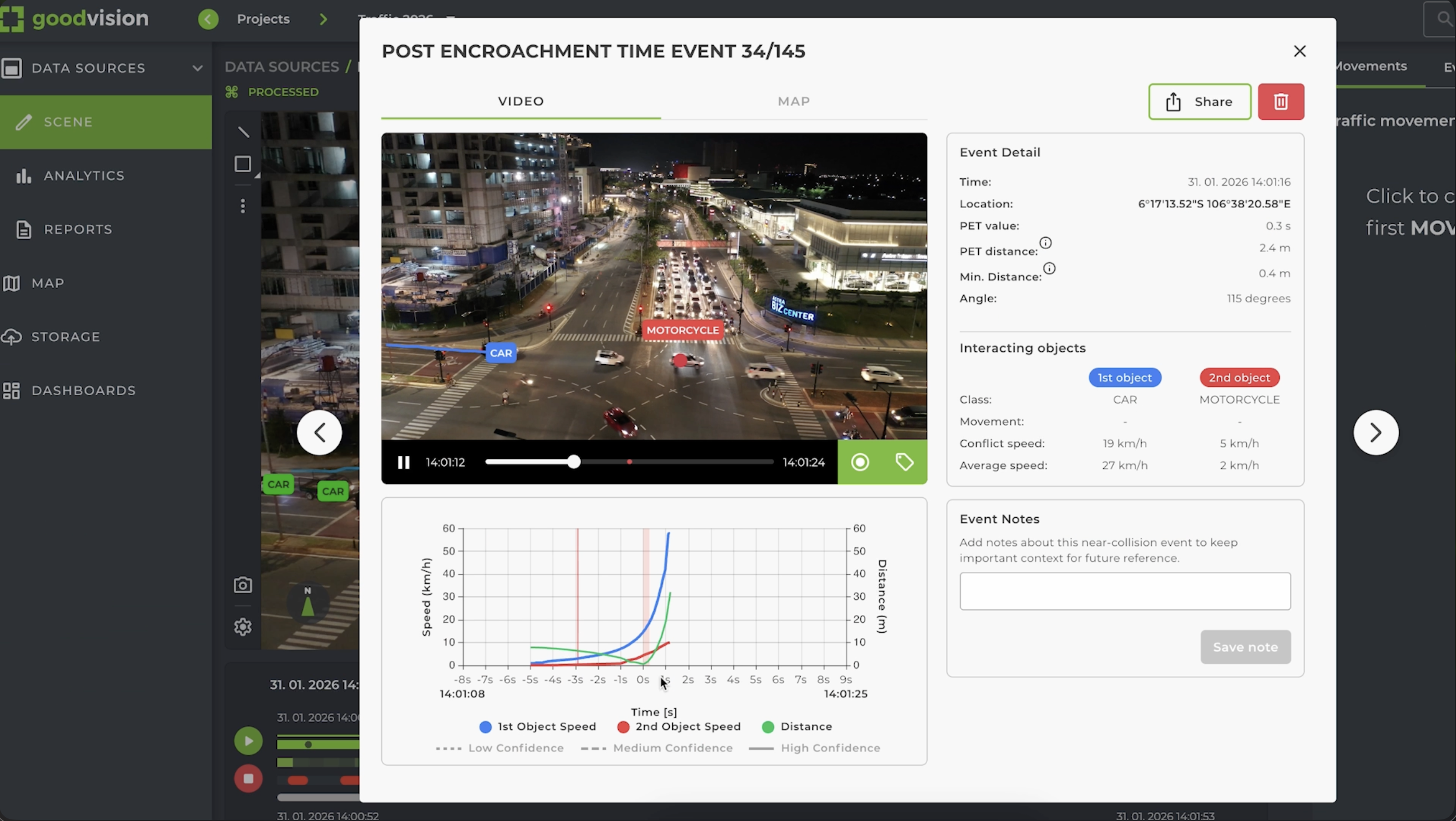
GoodVision's approach to conflict analysis runs across two complementary products. Video Insights handles retrospective analysis — upload footage from any existing camera, and the platform extracts full trajectory data for every road user, computes PET and TTC metrics, and generates conflict point maps and heatmaps. Processing takes 1–2 hours regardless of video length, using parallel cloud infrastructure. The output is audit-ready, exportable data suitable for safety scheme appraisals and client deliverables.
[Live Traffic](https://blog.goodvisionlive.com/ai-near-miss-detection-vision-zero-traffic-safety) extends the same capability to real-time monitoring. Edge hardware deployed at the camera site processes feeds locally with an alert latency of under one second. When a conflict event exceeds threshold parameters, the TMC receives an immediate notification. Over time, the system builds a conflict history that reveals patterns — time-of-day clustering, approach-specific risks, vehicle class interactions — that no manual review programme could produce at equivalent cost.
Both products work with existing camera infrastructure. There is no requirement to replace hardware or lock into proprietary sensors. For authorities that have already invested in camera networks, the incremental cost of adding AI-powered conflict analysis is a fraction of what a comparable manual programme would require. As part of any broader [data analytics framework supporting Vision Zero goals](https://blog.goodvisionlive.com/data-analytics-vision-zero), the platform sits alongside existing TMC workflows rather than replacing them.
## 
## From Reactive to Proactive: A Real-World Example
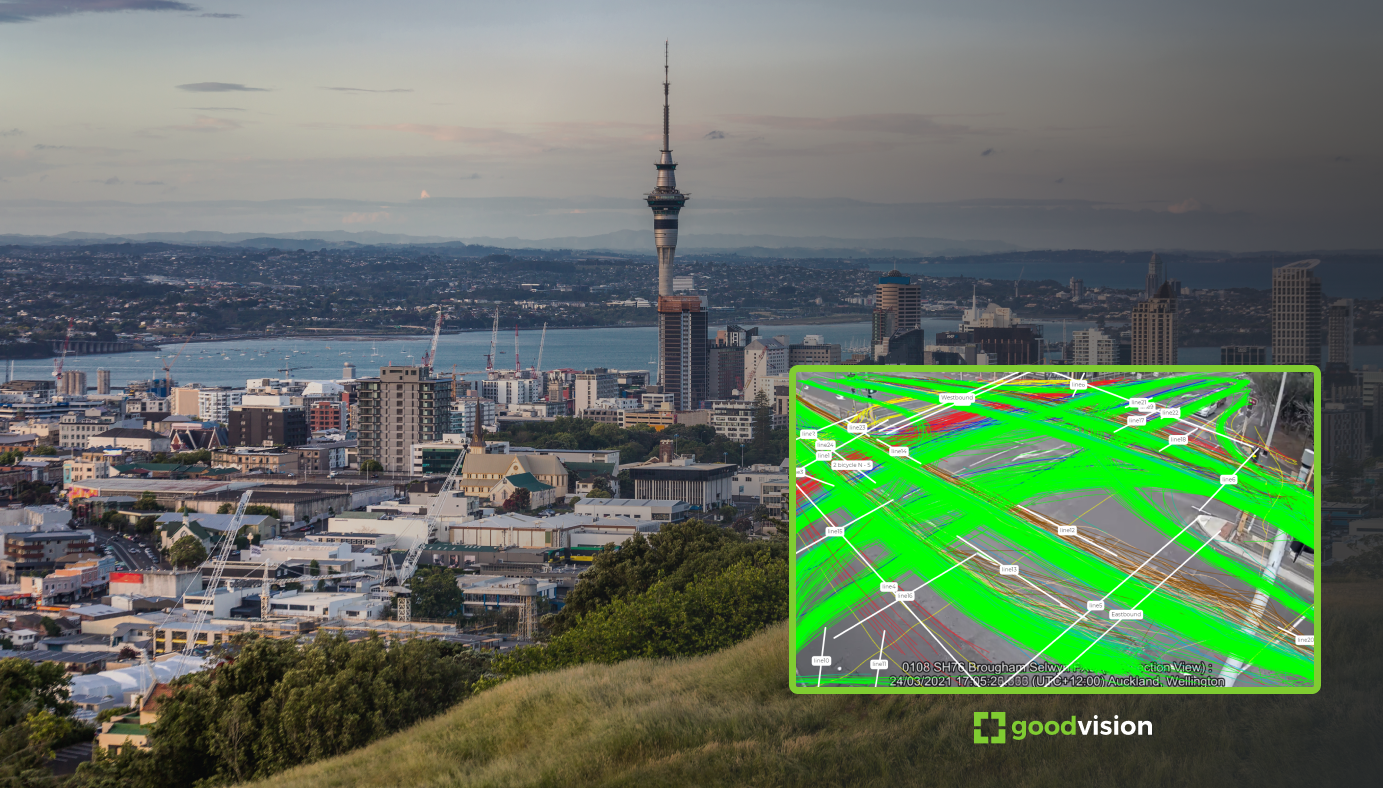
The shift from reactive safety management to proactive conflict monitoring is already operational at Waka Kotahi NZ Transport Agency, New Zealand's national transport authority. Working with GoodVision's platform, the agency applied video analytics to extract granular behavioural data — speed profiles, conflict events, trajectory deviations — that informs both network operations and longer-term safety investment decisions. The [Waka Kotahi case study](https://casestudies.goodvisionlive.com/case-study-nzta) demonstrates how a national-scale authority can operationalise safety analytics without rebuilding its camera infrastructure or expanding its analyst team.
For city-level deployments, the same pattern holds. Authorities that have committed to zero-fatality targets need a monitoring methodology that can tell them whether risk is increasing or decreasing across the network — not just at sites where crashes have already occurred. That requires data at a volume and frequency that only automated detection can provide.
## Start Treating Near-Misses as the Data They Are
Road safety is a data problem before it is an engineering problem. The events that predict future fatalities are already being recorded on your camera network. The question is whether your authority has the tools to act on them at the speed the problem demands.
See how GoodVision's Road Safety Analytics can replace your manual audit workflow — [request a demo at goodvisionlive.com/request-demo/](https://goodvisionlive.com/request-demo/).
---
Tags: [Road Safety Analytics](https://blog.goodvisionlive.com/tag/road-safety-analytics)
[Back to Blog](https://blog.goodvisionlive.com)
##### Subscribe to our Newsletter
Get latest updates and news about GoodVision directly to your inbox
Subscribe
[](https://goodvisionlive.com/)
###### Products
- [GoodVision Video Insights](https://goodvisionlive.com/goodvision-video-insights/)
- [GoodVision Live Traffic](https://goodvisionlive.com/goodvision-live-traffic/)
###### Company
- [About GoodVision](https://goodvisionlive.com/about-goodvision/)
- [Our Vision](https://goodvisionlive.com/our-vision/)
- [Careers](https://goodvisionlive.com/careers/)
- [Press kit](https://goodvisionlive.com/press-kit/)
###### Resources
- [Blog](https://blog.goodvisionlive.com/)
- [Case Studies](https://casestudies.goodvisionlive.com/)
- [Webinars](https://goodvisionlive.com/webinars/)
Copyright © 2026 GoodVision Ltd.
All rights reserved
[Privacy Policy](https://goodvisionlive.com/privacy-policy)
[Terms of Service](https://goodvisionlive.com/terms-of-service)
-
-
-
-
```json
{
"@context" : "https://schema.org",
"@type" : "BlogPosting",
"author" : {
"@type" : "Person",
"name" : "Tomas Bui",
"url" : "https://blog.goodvisionlive.com/author/tomas-bui"
},
"dateModified" : "2026-05-27T14:05:34.397Z",
"datePublished" : "2026-05-21T15:07:55.000Z",
"headline" : "How Transport Authorities Use Vision AI Instead of Manual Audits",
"image" : [ "https://blog.goodvisionlive.com/hubfs/How%20Transport%20Authorities%20Use%20Vision%20AI.png" ],
"mainEntityOfPage" : {
"@id" : "https://blog.goodvisionlive.com/how-transport-authorities-use-vision-ai-instead-of-manual-audits",
"@type" : "WebPage"
},
"publisher" : {
"@type" : "Organization",
"logo" : {
"@type" : "ImageObject",
"url" : "https://blog.goodvisionlive.com/hubfs/aas-1.png"
},
"name" : "GoodVision Ltd"
}
}
```
```json
{
"@context" : "https://schema.org",
"@type" : "VideoObject",
"contentUrl" : "https://20473359.fs1.hubspotusercontent-eu1.net/hubfs/20473359/5%20-%20Near%20Collisions%20Video.mp4",
"dateModified" : "2026-06-01T16:06:04.538Z",
"duration" : "PT1M28S",
"height" : 892,
"name" : "5 - Near Collisions Video",
"thumbnailUrl" : "https://api-na1.hubspot.com/filemanager/api/v3/files/thumbnail-redirect/213184847707?portalId=20473359&size=medium",
"uploadDate" : "2026-05-19T13:59:58.431Z",
"width" : 1564
}
```
```json
{
"@context" : "https://schema.org",
"@type" : "BlogPosting",
"author" : {
"@type" : "Organization",
"name" : "GoodVision",
"url" : "https://www.goodvisionlive.com"
},
"dateModified" : "2026-05-21T15:07:55Z",
"datePublished" : "2026-05-21T15:07:55Z",
"description" : "How transport authorities use video AI to automate conflict studies, detect near-misses in real time, and replace costly manual safety audits at network scale.",
"headline" : "How Transport Authorities Use Vision AI Instead of Manual Audits",
"image" : "https://20473359.fs1.hubspotusercontent-na1.net/hubfs/20473359/How%20Transport%20Authorities%20Use%20Vision%20AI.png",
"mainEntityOfPage" : {
"@id" : "https://blog.goodvisionlive.com/how-transport-authorities-use-vision-ai-instead-of-manual-audits",
"@type" : "WebPage"
},
"publisher" : {
"@type" : "Organization",
"logo" : {
"@type" : "ImageObject",
"url" : "https://20473359.fs1.hubspotusercontent-na1.net/hubfs/20473359/GoodVision_logo_full_GREEN.png"
},
"name" : "GoodVision",
"url" : "https://www.goodvisionlive.com"
},
"url" : "https://blog.goodvisionlive.com/how-transport-authorities-use-vision-ai-instead-of-manual-audits"
}
```