---
title: Ask These Questions About AI Traffic Data at ITE Detroit
description: Explore how to maximize existing camera networks with AI at ITE Detroit in 2026. Discover key questions to enhance traffic data collection and improve safety outcomes.
image: https://blog.goodvisionlive.com/hubfs/Ask%20These%20Questions%20About%20AI%20Traffic%20Data%20at%20ITE%20Detroit.png
---
###### Stay in touch
### Subscribe to Newsletter
Get latest updates and news about GoodVision directly to your inbox.
[](https://goodvisionlive.com/)
[](https://goodvisionlive.com/)
- [Free demo](https://goodvision.typeform.com/freetrial25?utm_source=gv-blog&utm_medium=menu)
- [Case studies](https://casestudies.goodvisionlive.com)
- [Blog](https://blog.goodvisionlive.com)
- [Return to homepage](https://goodvisionlive.com/)
[Contact us](https://goodvisionlive.com/contacts/)
[](https://goodvisionlive.com/)
- [Case studies](https://casestudies.goodvisionlive.com)
- [Blog](https://blog.goodvisionlive.com)
- [Return to homepage](https://goodvisionlive.com/)
- [Contact us](https://goodvisionlive.com/contacts)
[](https://goodvisionlive.com/)
[](https://goodvisionlive.com/)
- [Solutions](https://goodvisionlive.com/solutions/)
- [Products](https://goodvisionlive.com/products/)
- [Video Insights Platform](https://goodvisionlive.com/goodvision-video-insights/)
- [GoodVision Live Traffic](https://goodvisionlive.com/goodvision-live-traffic/)
- Partners
- [Global Sales Partners](https://goodvisionlive.com/partners/)
- [Technology Partners](https://goodvisionlive.com/technology-partners/)
- [Academy Program](https://goodvisionlive.com/goodvision-academy/)
- Resources
- [Case Studies](https://casestudies.goodvisionlive.com/)
- [Help Portal](https://goodvisionlive.com/support/)
- [Webinars](https://goodvisionlive.com/webinars/)
- [Blog](https://blog.goodvisionlive.com/)
- [Company](https://goodvisionlive.com/about-goodvision/)
- [About GoodVision](https://goodvisionlive.com/about-goodvision/)
- [Our Vision](https://goodvisionlive.com/our-vision/)
- [Careers](https://goodvisionlive.com/careers/)
- [Press kit](https://goodvisionlive.com/press-kit/)
- [Contact us](https://goodvisionlive.com/contacts/)
[Contact us](https://goodvisionlive.com/contacts/)
[](https://goodvisionlive.com/)
- [Solutions](https://goodvisionlive.com/solutions/)
- [Products](https://goodvisionlive.com/products/)
- [Video Insights Platform](https://goodvisionlive.com/goodvision-video-insights/)
- [GoodVision Live Traffic](https://goodvisionlive.com/goodvision-live-traffic/)
- Partners
- [Global Sales Partners](https://goodvisionlive.com/partners/)
- [Technology Partners](https://goodvisionlive.com/technology-partners/)
- [Academy Program](https://goodvisionlive.com/goodvision-academy/)
- Resources
- [Case Studies](https://casestudies.goodvisionlive.com/)
- [Help Portal](https://goodvisionlive.com/support/)
- [Webinars](https://goodvisionlive.com/webinars/)
- [Blog](https://blog.goodvisionlive.com/)
- [Company](https://goodvisionlive.com/about-goodvision/)
- [About GoodVision](https://goodvisionlive.com/about-goodvision/)
- [Our Vision](https://goodvisionlive.com/our-vision/)
- [Careers](https://goodvisionlive.com/careers/)
- [Press kit](https://goodvisionlive.com/press-kit/)
- [Contact us](https://goodvisionlive.com/contacts/)

# Ask These Questions About AI Traffic Data at ITE Detroit
Jul 8, 2026, 1:21:22 PM
At ITE, the conversation on the exhibit floor tends to circle back to the same starting point: a city traffic engineer or a system integrator mentions they've got cameras at every major intersection and corridor already, and someone nods, because most agencies do. The question worth asking has changed. It's no longer "should we add AI to this." It's "our cameras are already there — can we use today's advanced AI technology to extract the data?"
If you're heading to ITE Detroit this year, that's the question to lead with — and it's an operational one, not a theoretical one. Highway operators are trying to cut incident response times without adding new detection hardware to every mile of corridor. City authorities are trying to build a defensible Vision Zero case with near-miss and conflict data they don't currently collect. System integrators are trying to add a safety and monitoring layer to a deployment without reopening a camera procurement cycle. None of that starts with new sensors. It starts with getting more out of the ones already on the pole.
Here are the questions worth asking on the floor, and where the answers actually sit.
## The Questions to Ask
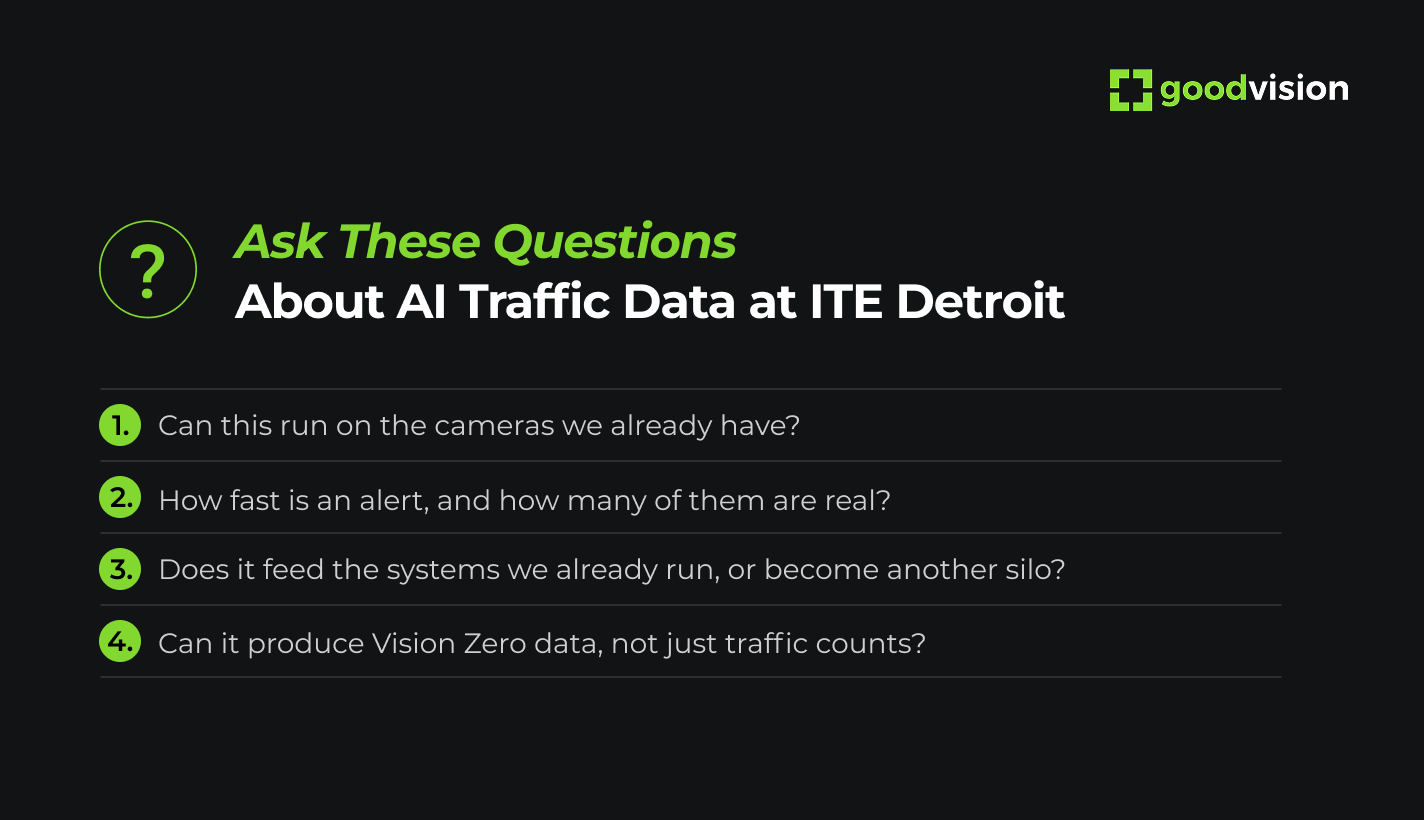
**Can this run on the cameras we already have?** Most existing CCTV networks were installed for visual monitoring, not structured data collection — an operator watches a feed, or reviews footage after an incident. The camera hardware itself is rarely the limiting factor. What's missing is a layer that reads the same RTSP stream in real time and turns it into structured events: counts, speeds, occupancy, incidents. That layer runs on an edge AI unit connected to the existing camera network — not a new camera on every pole.
**How fast is an alert, and how many of them are real?** For a traffic management centre, alert latency and false-positive rate decide whether a system gets used or gets muted. An incident detection tool that fires constantly on shadows, wipers, or parked vehicles trains operators to ignore it. The bar for automatic incident detection (AID) has to be sub-second alerting with zero false alerts — accidents, stopped vehicles, wrong-way drivers, and congestion build-up flagged in under a second, not a summary an operator reviews an hour later.
**Does it feed the systems we already run, or become another silo?** A detection tool that only displays on its own dashboard adds a screen, not a capability. Integrators and TMC operators need data that pushes via HTTPS or API directly into the systems already in place — signal controllers, V2X platforms, smart city middleware, emergency response systems — without a manual export step in between.
**Can it produce Vision Zero data, not just traffic counts?** Vision Zero programs run on near-miss and conflict data, not just volume. Historically, that data required specialist forensic video review, which made it too expensive to collect at scale. If a city wants defensible before/after safety data for a corridor or intersection redesign, the camera network needs to generate post-encroachment time and time-to-collision data continuously, not as a one-off study.
## Where Generic Video Monitoring Falls Short
Plenty of tools can watch a camera feed. Fewer turn that feed into data a TMC, a signal system, or a Vision Zero program can actually use.
The first gap is the extraction gap itself: video that's recorded but never structured. A camera network with years of footage and no consistent incident, count, or conflict data behind it isn't short on infrastructure — it's short on a layer that reads what's already there.
The second gap is false-alert fatigue. Incident detection tools that aren't validated against real-world conditions — rain, glare, camera shake, partial occlusion — generate enough noise that operators stop trusting the alerts, which defeats the purpose of automating detection in the first place.
The third gap is fragmentation. Real-time monitoring, historical safety analysis, and modeling data often run on separate tools that don't share a data model, which means a near-miss event flagged by one system has to be manually reconciled with a signal timing record from another. A single platform that unifies live monitoring and historical analysis removes that reconciliation step entirely.
A fourth gap shows up at the object class level. Generic models are often trained on a narrow slice of traffic conditions, so they miss the road users and vehicle types that don't match their training set. GoodVision's AI engines are trained on more than 2 billion real data points, with dedicated engines covering the object classes each region and use case actually needs — from standard vehicle and pedestrian classes to region-specific types. And when a project calls for a class that isn't covered yet, GoodVision can train a new object class detection model fast, rather than leaving that traffic quietly uncounted. Contact us for more details.
## What This Looks Like in Practice
Highway and toll operators run GoodVision Live Traffic on their existing camera infrastructure for exactly this reason: real-time incident detection and structured traffic data without adding new roadside hardware. An edge AI unit connects to the camera streams already in place, processes them on-site, and pushes structured events — incidents, counts, speeds, occupancy — to the traffic management centre or ITS platform in under a second.
The same platform also runs GoodVision's near-miss detection, so the data supporting a Vision Zero program comes from the same infrastructure feeding day-to-day operations, rather than a separate forensic study. That's the difference between treating safety data as a periodic project and treating it as a continuous output of infrastructure the agency already owns.
For system integrators, the model is straightforward to add to an existing bid or deployment: the analytics layer runs on GoodVision's hardware, on a customer-owned edge device, or directly inside compatible AXIS cameras, and connects into TMC, V2X, and signal control systems through a documented API rather than a proprietary closed system.
ITE Detroit is where these questions get specific answers — what an integration actually looks like, what a TMC needs to trust an alert, what a Vision Zero data case requires to hold up. Ask them.
Stop by the GoodVision booth at ITE Annual Meeting 2026 in Detroit, July 19–22, or book a demo at goodvisionlive.com/request-demo/ to see what your existing camera network can produce.
[Back to Blog](https://blog.goodvisionlive.com)
##### Subscribe to our Newsletter
Get latest updates and news about GoodVision directly to your inbox
Subscribe
[](https://goodvisionlive.com/)
###### Products
- [GoodVision Video Insights](https://goodvisionlive.com/goodvision-video-insights/)
- [GoodVision Live Traffic](https://goodvisionlive.com/goodvision-live-traffic/)
###### Company
- [About GoodVision](https://goodvisionlive.com/about-goodvision/)
- [Our Vision](https://goodvisionlive.com/our-vision/)
- [Careers](https://goodvisionlive.com/careers/)
- [Press kit](https://goodvisionlive.com/press-kit/)
###### Resources
- [Blog](https://blog.goodvisionlive.com/)
- [Case Studies](https://casestudies.goodvisionlive.com/)
- [Webinars](https://goodvisionlive.com/webinars/)
Copyright © 2026 GoodVision Ltd.
All rights reserved
[Privacy Policy](https://goodvisionlive.com/privacy-policy)
[Terms of Service](https://goodvisionlive.com/terms-of-service)
-
-
-
-
```json
{
"@context" : "https://schema.org",
"@type" : "BlogPosting",
"author" : {
"@type" : "Person",
"name" : "Tomas Bui",
"url" : "https://blog.goodvisionlive.com/author/tomas-bui"
},
"dateModified" : "2026-07-08T11:21:22.191Z",
"datePublished" : "2026-07-08T11:21:22.000Z",
"headline" : "Ask These Questions About AI Traffic Data at ITE Detroit",
"image" : [ "https://blog.goodvisionlive.com/hubfs/Ask%20These%20Questions%20About%20AI%20Traffic%20Data%20at%20ITE%20Detroit.png" ],
"mainEntityOfPage" : {
"@id" : "https://blog.goodvisionlive.com/ite-detroit-preview-what-traffic-engineers-want-from-ai",
"@type" : "WebPage"
},
"publisher" : {
"@type" : "Organization",
"logo" : {
"@type" : "ImageObject",
"url" : "https://blog.goodvisionlive.com/hubfs/aas-1.png"
},
"name" : "GoodVision Ltd"
}
}
```
```json
{
"@context" : "https://schema.org",
"@type" : "VideoObject",
"contentUrl" : "https://20473359.fs1.hubspotusercontent-na1.net/hubfs/20473359/video_assets/216659620690/inherited/web_optimized.mp4",
"dateModified" : "2026-07-07T15:54:56.370Z",
"duration" : "PT9.02S",
"height" : 1234,
"name" : "Time to Collision Event - GoodVision",
"thumbnailUrl" : "https://api-na1.hubspot.com/filemanager/api/v3/files/thumbnail-redirect/216659620690?portalId=20473359&size=medium",
"uploadDate" : "2026-07-07T15:53:14.289Z",
"width" : 2550
}
```
```json
{
"@context" : "https://schema.org",
"@type" : "BlogPosting",
"author" : {
"@type" : "Organization",
"name" : "GoodVision",
"url" : "https://www.goodvisionlive.com"
},
"dateModified" : "2026-07-08T00:00:00Z",
"datePublished" : "2026-07-08T00:00:00Z",
"description" : "ITE Detroit preview: what traffic engineers need from AI traffic data now, accuracy, turnaround, saturation flows, and client-ready outputs.",
"headline" : "ITE Detroit Preview: What Traffic Engineers Want from AI Traffic Data Right Now",
"image" : "https://20473359.fs1.hubspotusercontent-na1.net/hubfs/20473359/GoodVision_logo_full_GREEN.png",
"mainEntityOfPage" : {
"@id" : "https://blog.goodvisionlive.com/ite-detroit-preview-what-traffic-engineers-want-from-ai-tra",
"@type" : "WebPage"
},
"publisher" : {
"@type" : "Organization",
"logo" : {
"@type" : "ImageObject",
"url" : "https://20473359.fs1.hubspotusercontent-na1.net/hubfs/20473359/GoodVision_logo_full_GREEN.png"
},
"name" : "GoodVision",
"url" : "https://www.goodvisionlive.com"
},
"url" : "https://blog.goodvisionlive.com/ite-detroit-preview-what-traffic-engineers-want-from-ai-tra"
}
```