Most cities already have the eyes. What they're missing is the brain. Urban road networks are blanketed with CCTV cameras mounted at intersections, on gantries, along arterial corridors. For most transport authorities, those feeds are monitored reactively: a supervisor watches when something goes wrong, or recordings are pulled after an incident. The rest of the time, the data sits unused. As urban growth continues to strain existing infrastructure, the operational cost of that passivity is compounding.
The gap between capturing video and extracting intelligence from it is where traffic operations teams lose the most ground. Congestion builds before anyone notices. Near-miss events happen without triggering a review. Incidents get logged after the fact rather than flagged in real time. The result is a system that responds to problems rather than prevents them.
The good news is that technology to close that gap now exists, and it works with the cameras already in the ground.
Why Existing Camera Networks Fall Short
Traditional traffic monitoring was designed to monitor, it was definitely intended to count vehicles and let alone to understand.
Loop detectors and pneumatic road tubes measure presence and volume at a single point. Legacy CCTV systems record footage that may never be reviewed. Manual monitoring depends on operator attention (a resource that's finite, expensive, and impossible to scale). The typical traffic management centre has screens full of live feeds and a fraction of the staff needed to watch them continuously. Incidents that don't trigger a phone call go undetected for minutes. Near-miss events, the leading predictor of future collisions, go unrecorded entirely.
This is a structural problem. Intelligent traffic management requires more than cameras on poles. Those cameras need to do more than just monitoring, they need a intelligence layer to do analytical work. The International Transport Forum estimates that urban congestion costs OECD economies hundreds of billions annually, yet most of the data that could reduce that figure is either not collected or not acted upon quickly enough to matter.
.jpg?width=1600&height=1067&name=automobile-congestion-in-the-morning-rush-hour-2021-08-26-17-53-07-utc%20(1).jpg)
What a Real-Time Intelligence Layer Actually Delivers
When AI processing is applied to live camera feeds, the output changes from passive footage to active operational insight. The difference is significant across four dimensions:
Incidents are flagged in under one second. A vehicle stopped in a live lane, a wrong-way movement, or a pedestrian entering a restricted zone: alerts arrive while intervention is still possible, not minutes later in a post-incident debrief.
Vehicle counts are continuous and classified by type. Rather than undifferentiated volume figures, a true intelligence layer tracks eight vehicle classes (cars, heavy goods vehicles, motorcycles, cyclists, pedestrians, and more) at every monitored point, 24 hours a day. For networks in APAC, the platform extends to a ten-class Singapore-standard scheme, the only commercially available system offering this classification depth.
Near-miss events are detected and logged in real time. Real-time data as a tool for improving road safety shifts safety programmes from lagging indicators like collision records to leading ones. Using Post-Encroachment Time (PET) and Time-to-Collision (TTC) metrics, near-miss events are detected and logged automatically, 90% faster than traditional forensic methods and at 80% lower cost than conventional road safety analysis. For authorities running Vision Zero commitments, this turns a camera network into an evidence base for targeted intervention, not just retrospective reporting.
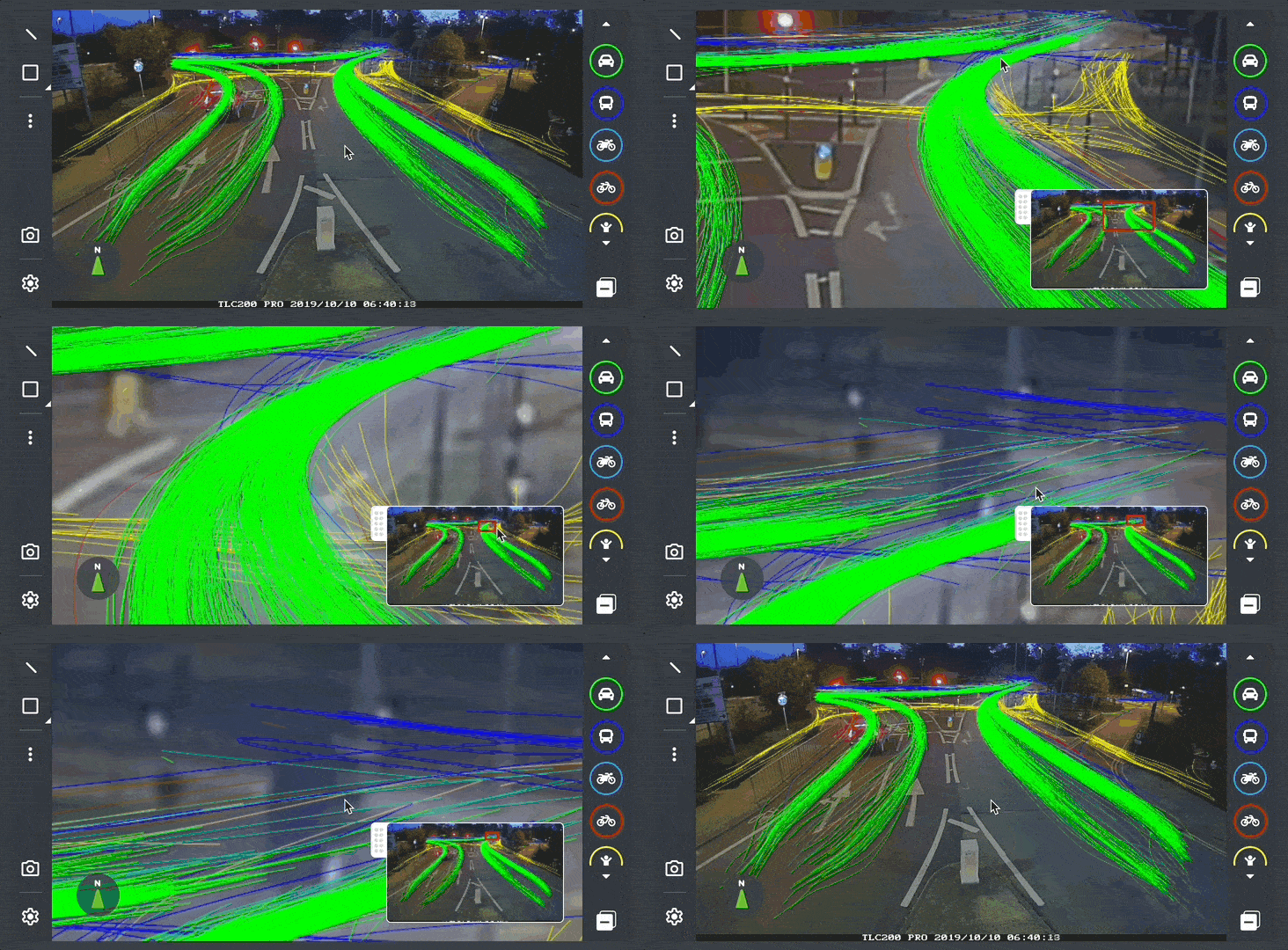
Every detected object generates a full movement trace. Speed, heading, acceleration, and dwell time are tracked continuously. That trajectory layer feeds directly into congestion modelling, intersection performance reviews, and signal timing decisions. The four core operational benefits of real-time traffic data (responsiveness, accuracy, coverage, and efficiency) each depend on this kind of persistent, per-object tracking. According to the WHO, road traffic crashes kill 1.19 million people annually. The data to prevent many of those events is already being captured on city camera networks. The question is whether it is being used.

How GoodVision Turns Camera Networks Into Operational Intelligence
GoodVision Live Traffic is edge-deployed hardware that connects to any IP camera (existing or newly installed) and begins producing intelligence immediately. There is no rip-and-replace, no proprietary camera lock-in, and no extended integration project before the first insight is available.
Once deployed, the system delivers 95%+ accuracy on vehicle counts and classifications with alert latency under one second. The data footprint is 1,000× smaller than raw video, which reduces storage overhead and simplifies compliance with data privacy requirements. Alerts, dashboards, and structured traffic metrics are available through a central platform, accessible to TMC operators and senior transport managers without specialist configuration.
The Traffic Safety Suite adds automated near-miss detection on top of the standard monitoring layer. For authorities managing safety KPIs or reporting to national road safety frameworks, this creates a continuous, timestamped record of conflict events, the kind of defensible evidence base that manual monitoring simply cannot produce at scale.
GoodVision Vault handles secure cloud storage for video assets associated with flagged events, keeping footage available for review without maintaining full raw archives across the network.
Proven at Scale: Attikes Diadromes and Beyond
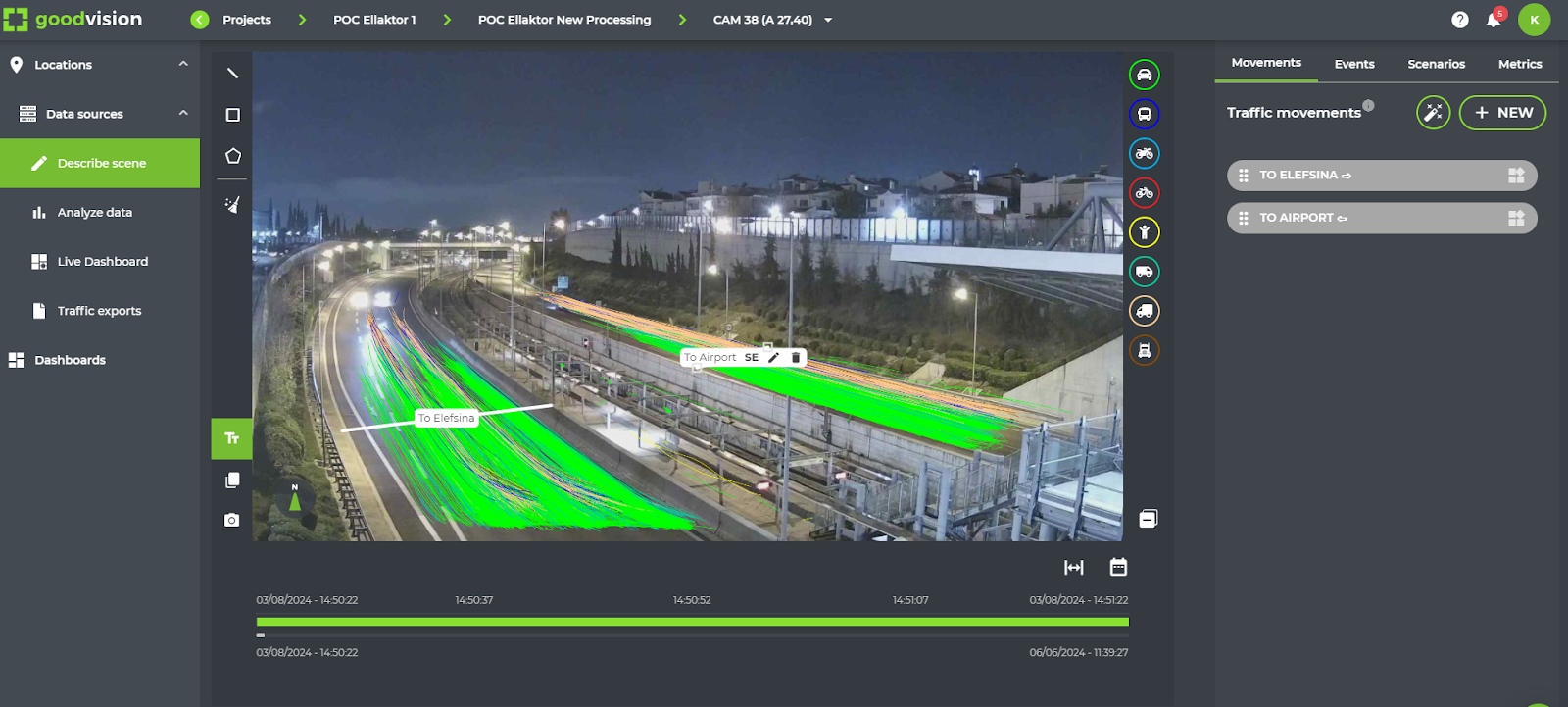
The Attikes Diadromes highway network deployed GoodVision Live Traffic to move beyond loop-based monitoring across its managed corridors. The result was a persistent, real-time view of vehicle behaviour, classification, and corridor performance. That data feeds directly into congestion management decisions without requiring additional field staff or replacement of installed cameras.
More and more agencies and highway operator around the world have drawn on the same approach: connecting existing camera infrastructure to GoodVision's processing layer and extracting operational intelligence that was previously unavailable. In each case, the hardware was already there. What changed was what it could see.
A CCTV network without analytical processing is a liability management tool at best. With the right AI layer, the same infrastructure becomes a real-time intelligence platform. It detects incidents before they cascade, tracks safety-critical events before they become statistics, and gives operations teams the situational awareness needed to act rather than react.
See what your existing camera network can tell you. Request a demo at goodvisionlive.com/request-demo/ and we'll show you Live Traffic running on infrastructure like yours.