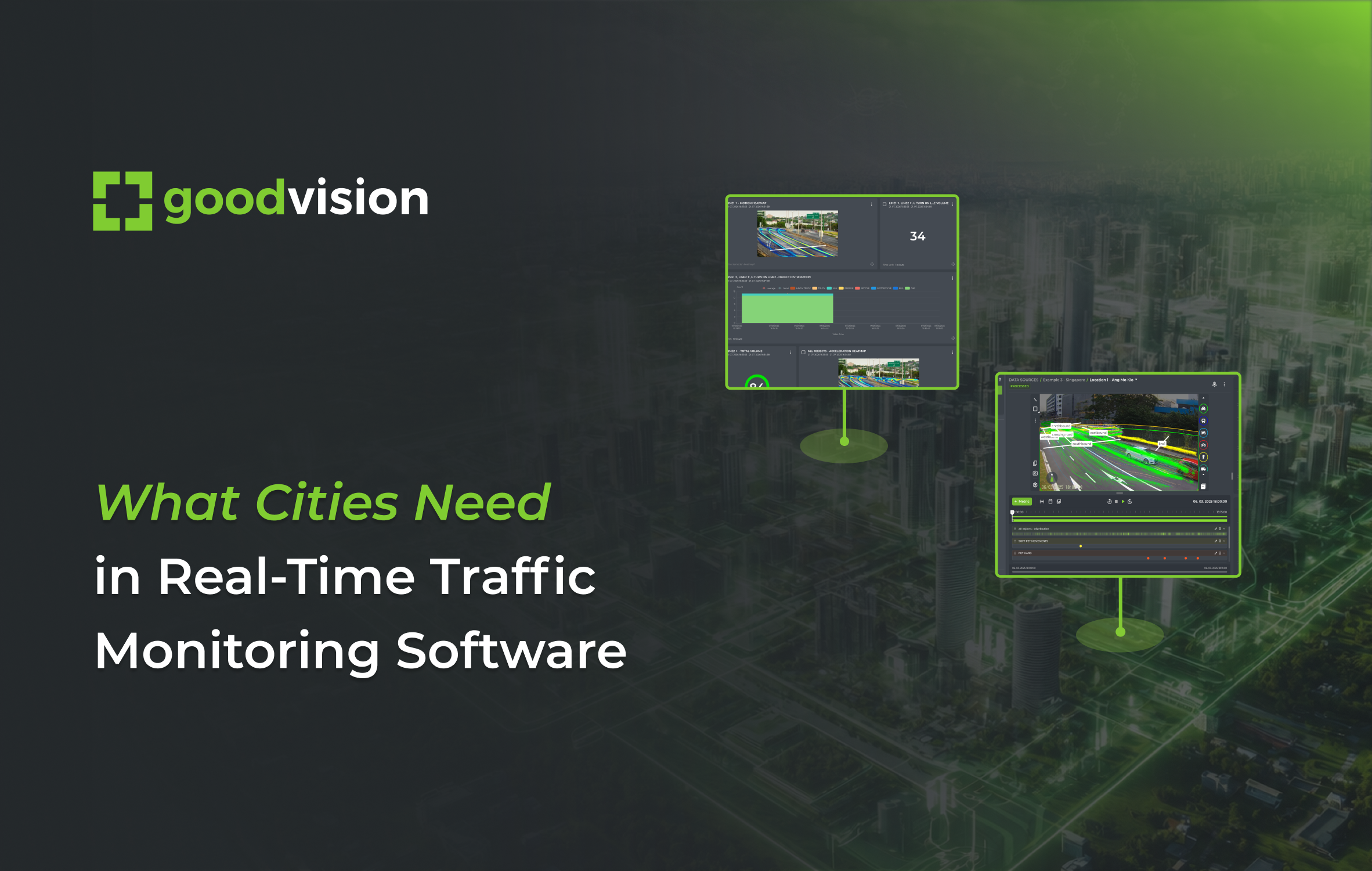
Real-time traffic monitoring software works for a city only when it meets three conditions: it runs on cameras the city already owns, it flags incidents in under a second, and it produces data an operations team can act on without a data science degree. Most deployments stall because one of those three is missing, not because the AI itself is weak.
Municipal transportation departments do not lack data. Traffic cameras, loop detectors, and connected signals already generate a constant stream of it. What they lack is a way to turn that stream into decisions fast enough to matter. A traffic incident that takes ten minutes to detect and another twenty to confirm has already caused the congestion it was supposed to prevent. That gap, not a shortage of hardware, is the real urban traffic management problem cities are trying to solve.
.gif?width=700&height=394&name=DetectionGapVideo%20(2).gif)
What Is Real-Time Traffic Monitoring Software?
Real-time traffic monitoring software is a system that analyzes live video or sensor feeds continuously and surfaces traffic conditions, incidents, and flow data as they happen, rather than after footage is reviewed or reports are compiled. It differs from traditional traffic data collection, which processes recorded video after the fact for surveys and planning studies.
The distinction matters for how a Traffic Operations Manager evaluates a system. A platform built for traffic data analytics after a survey period is a different tool from one built to watch a corridor around the clock and alert staff the moment something goes wrong. Cities often need both, but they solve different jobs.
What Capabilities Actually Make It Work on a Municipal Network?
The software has to work with cameras the city already has, or the deployment cost kills the project before it starts. Municipal budgets rarely stretch to replace CCTV infrastructure just to add analytics on top of it.
Beyond camera compatibility, five capabilities separate a system that gets used from one that gets shelved:
| Capability | Why it matters for a city | What to check before buying |
|---|---|---|
| Camera-agnostic deployment | Works with existing CCTV, no new hardware procurement cycle | Does it require a specific camera brand or model? |
| Sub-second alert latency | Incident response starts before congestion builds | What is the measured latency from event to alert? |
| Low false-alarm rate | Operators trust and act on alerts instead of ignoring them | Is the false-alarm rate independently validated? |
| Structured data output | Feeds signal timing, dashboards, and reports without manual re-entry | Does it export via API or only as raw video? |
| Multimodal detection | Captures pedestrians and cyclists, not just vehicles | Is accuracy validated separately for each road user type? |
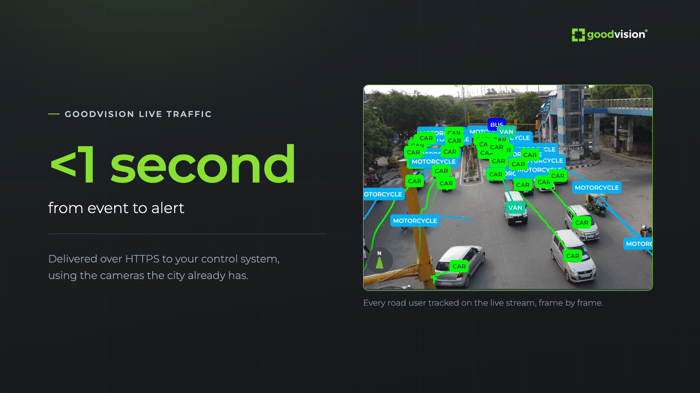
GoodVision Live Traffic delivers alerts in under 1 second over HTTPS and has been validated with zero false alarms in independent testing, using cameras cities already have installed. That combination, not raw detection accuracy alone, is what determines whether an operations team keeps using the system after the pilot ends.
Why Does Adoption Stall in City Traffic Management?
Adoption stalls when the software produces data that operations staff cannot act on inside their existing workflow. A dashboard full of detections is not useful if it does not connect to the signal control system, the incident log, or the report a director needs for a council meeting.
Municipal technology challenges compound this. Procurement cycles are long, IT teams need to vet data ownership and GDPR compliance before anything touches city infrastructure, and staff turnover means the person who championed the pilot may not be there for the rollout. GoodVision's data privacy policy addresses the ownership question directly: the city owns its data, and GoodVision processes it, rather than owning it.
The other common stall point is scale. A system that works on one intersection during a demo often cannot handle a citywide rollout without added headcount to manage it. Choosing traffic control software: top considerations for your city covers the procurement criteria that catch this before a contract is signed, not after.
How Is GoodVision Live Traffic Different for City Operations?
GoodVision Live Traffic turns any existing CCTV camera into a live traffic data source, without new hardware or a proprietary camera ecosystem. Aarhus, Denmark used it for live monitoring of accessible parking spaces at the train station and on Skovvejen, covering occupancy status, analytics, and misuse of those spaces. Installation, calibration, and go-live were completed in a single day, documented in the Aarhus deployment write-up.
GoodVision also delivers through local partners. ATKI, a traffic engineering and ITS provider working across traffic counting, smart parking, and road safety, is a GoodVision partner in Denmark.
For a city evaluating this category, the useful comparison is not "AI versus manual monitoring." It is whether a given platform gives an operations team an alert they can act on inside the first second, using cameras already bolted to the poles. Intelligent traffic management: the secret of smart cities looks at how that shift changes day-to-day operations for a traffic management center.
What Should Cities Do Before Signing a Contract?
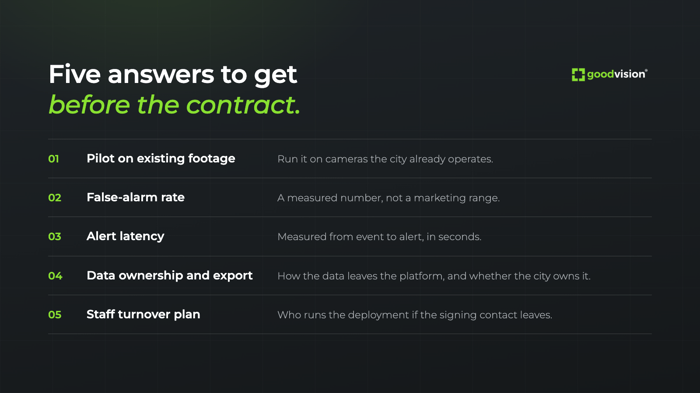
Run a pilot on existing footage before committing to a citywide deployment. A short pilot on cameras the city already operates answers the accuracy and integration questions that a vendor demo cannot.
Ask for the false-alarm rate and the alert latency as measured numbers, not marketing ranges. Ask how the data leaves the platform and whether it is your data or the vendor's. And ask what happens to the deployment if the staff member who signed the contract leaves within a year, since contact turnover is one of the most common reasons transport agencies stop using a platform they otherwise rated highly.
The U.S. Department of Transportation's Intelligent Transportation Systems Joint Program Office documents automatic incident detection benefits for congestion management as part of its broader ITS research, useful independent context when a vendor's own numbers are the only ones on the table. For safety-focused deployments, Vision Zero Network publishes the framework many U.S. and European cities now use to justify traffic safety technology investment to elected officials.
Real-time traffic monitoring software solves a specific municipal problem: closing the gap between when something happens on a road network and when the right person finds out. Get the camera compatibility, latency, and data ownership questions answered before the contract, and adoption stops being the risk.
Book a demo at goodvisionlive.com/request-demo/ and see how Live Traffic performs on footage from your own network within days.