Summary
- Cities delay adopting real-time traffic monitoring software mainly over integration risk and procurement friction, not because the underlying computer vision technology is unproven.
- Legacy loop detectors and hardware-locked systems make camera-based platforms look like a bigger capital project than they are, even when the software runs on cameras a city already owns.
- Traffic operations centers typically run procurement cycles designed for physical infrastructure like signal cabinets and loop sensors, and applying that same cycle to a software license adds months with no construction phase to justify it.
- Data ownership and GDPR questions stall smart city procurement reviews longer than the technical evaluation itself, because most agencies have no existing template for reviewing an AI vendor's video data policy.
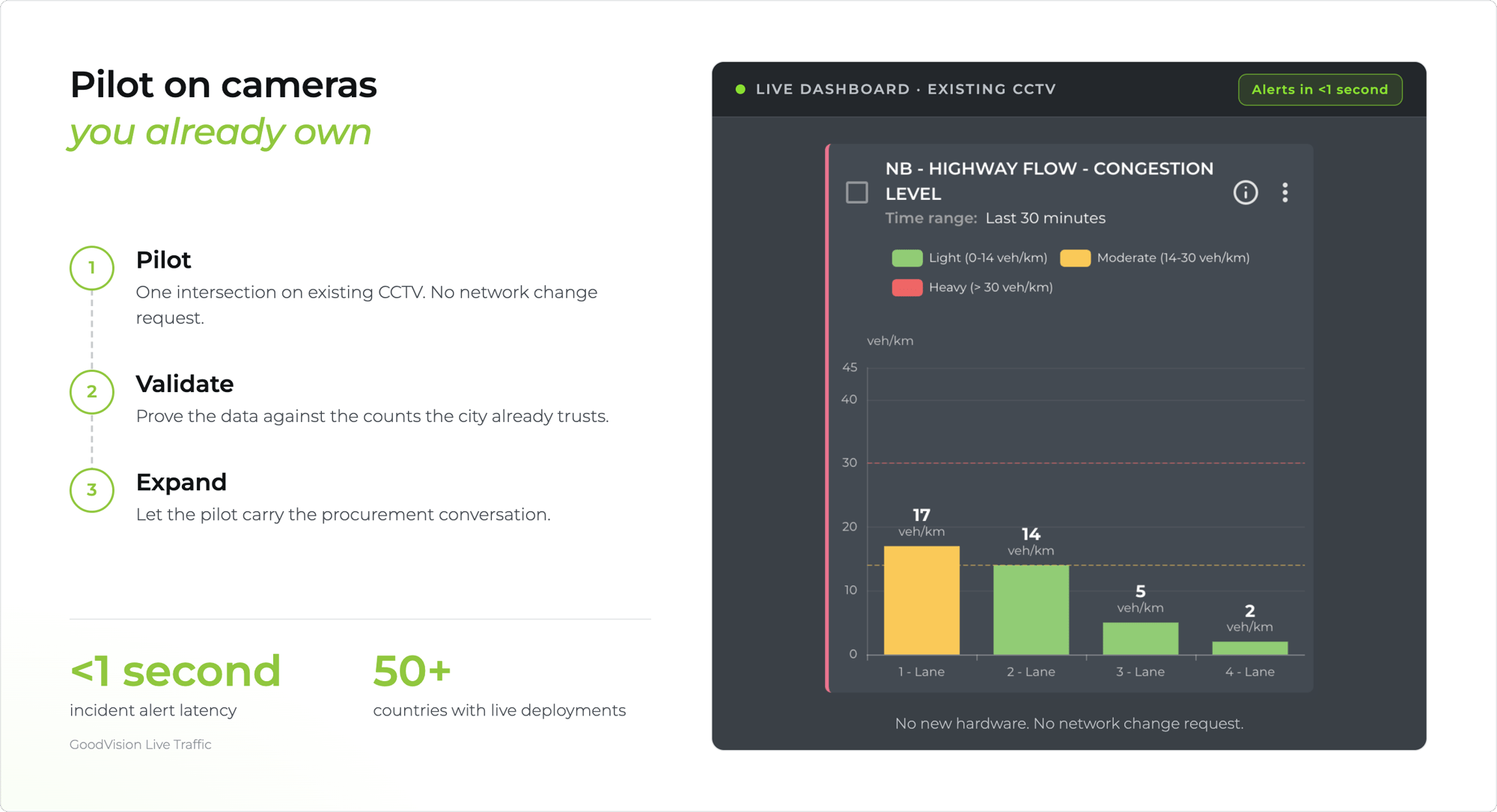
- GoodVision Live Traffic delivers incident alerts in under 1 second over HTTPS and runs on cameras a city already operates, which keeps new-hardware procurement out of the first phase of the project.
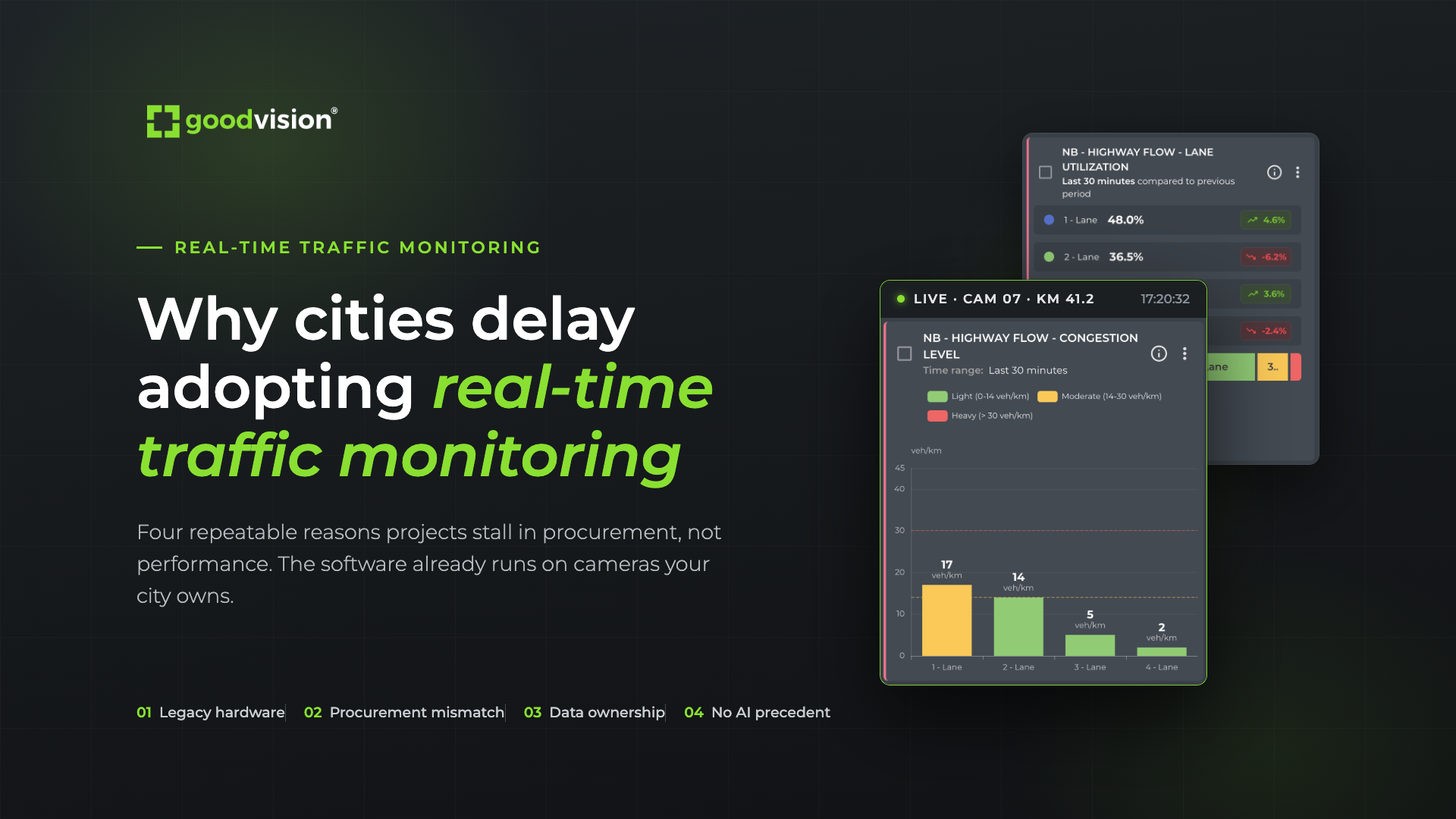
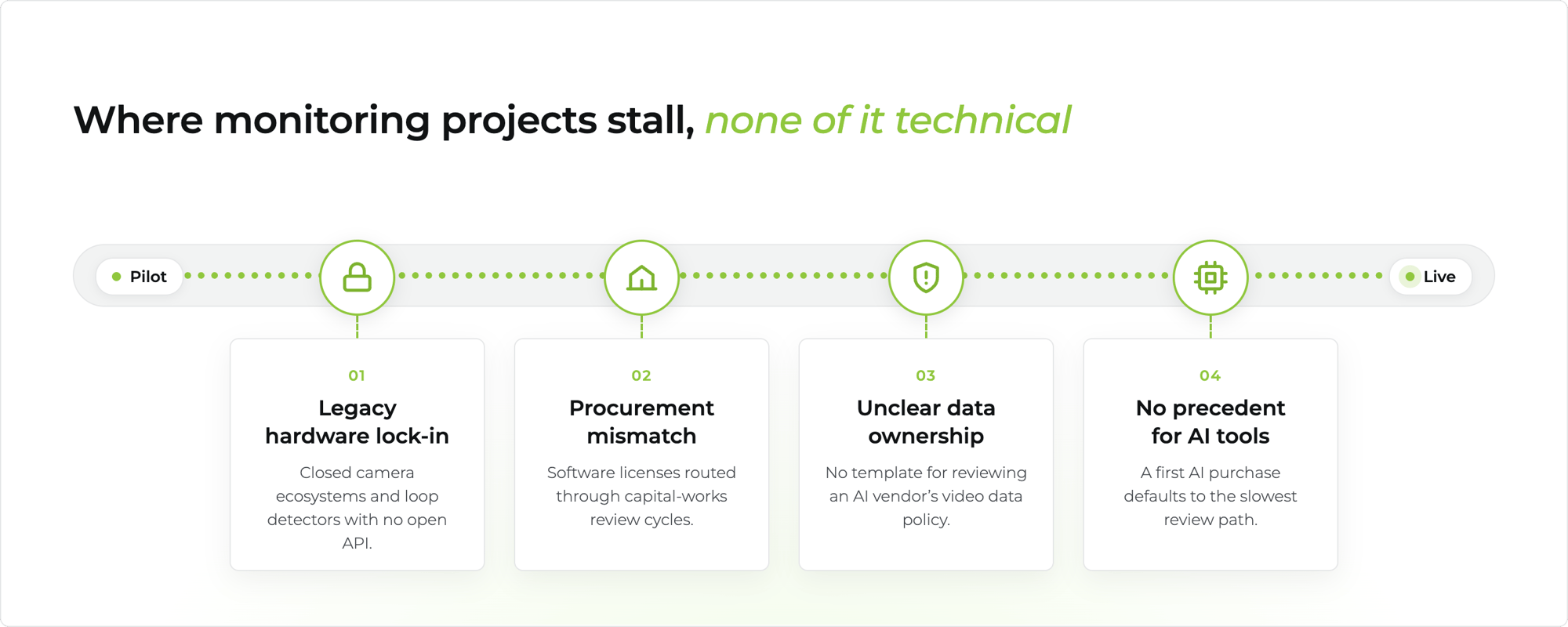
Real-time traffic monitoring software stalls inside cities for four repeatable reasons: legacy hardware dependency, procurement processes built for construction rather than software, unclear data ownership rules, and a lack of internal precedent for AI-based operations tools. None of these are technology problems. GoodVision Live Traffic, for example, processes existing camera feeds and returns incident alerts in under 1 second over HTTPS. The bottleneck sits in how cities buy and approve technology, not in whether the technology works.
That distinction matters right now. Traffic operations managers are under pressure to modernize city traffic management as camera networks age out and federal and municipal budgets tighten. Understanding exactly where a real-time monitoring project stalls, rather than treating "the city is slow" as an unavoidable fact, is what gets a project from pilot to procurement.
What Is Real-Time Traffic Monitoring Software?
Real-time traffic monitoring software is a platform that processes live video or sensor feeds continuously and returns traffic data, such as vehicle counts, classifications, and incident alerts, within seconds rather than after the fact. It differs from traffic survey tools, which process recorded footage after a study period ends, and from static sensors, which report presence or speed but not classification or behavior.
The category sits inside a broader shift toward AI-driven urban infrastructure technology, where cities apply computer vision to assets they already operate (traffic cameras, highway CCTV, intersection cameras) instead of installing new dedicated sensors for every use case. That shift is also why the buying process looks unfamiliar to agencies used to procuring physical hardware.
What Operational Barriers Stand in the Way of Real-Time Traffic Monitoring Software?
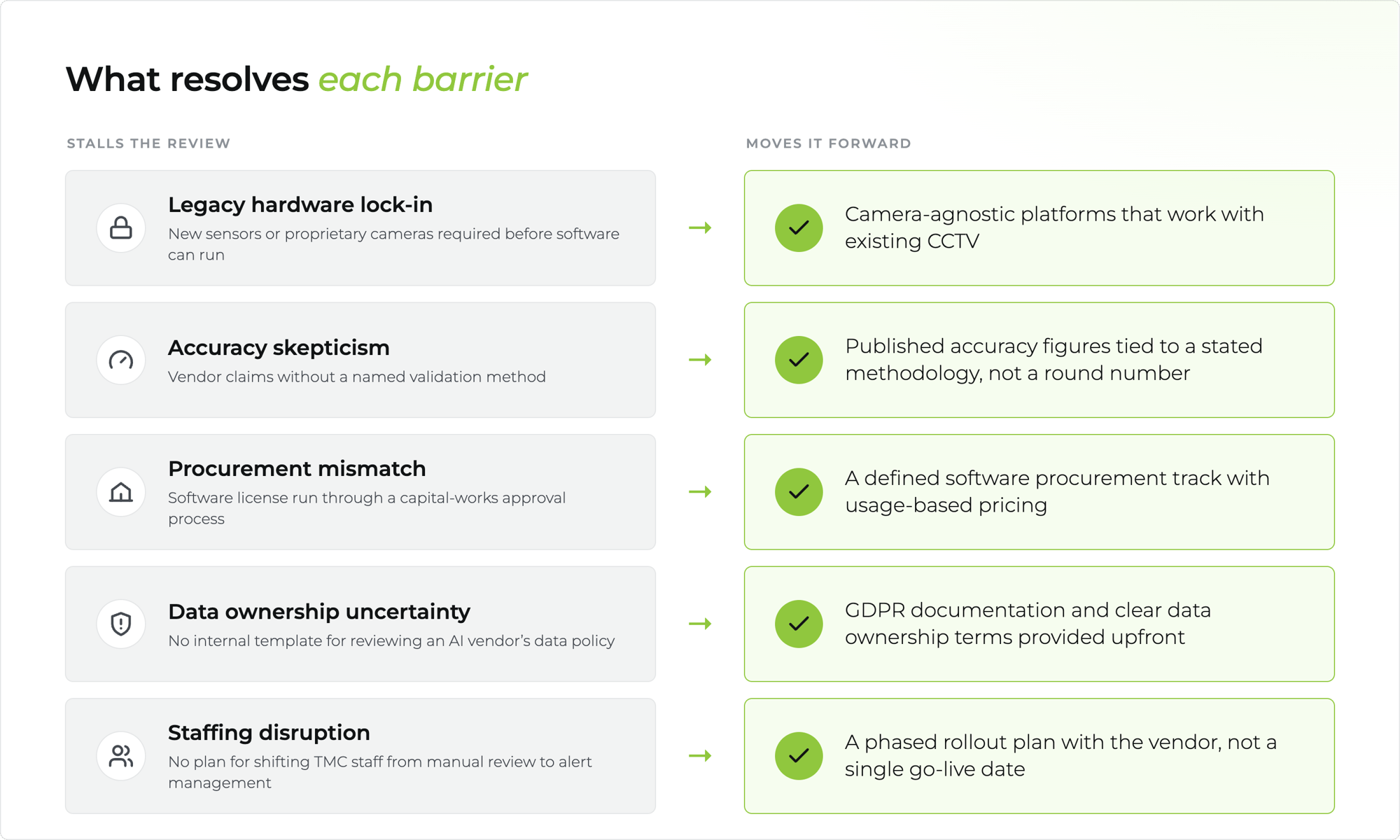
The biggest operational barrier is integration with legacy systems that were never designed to talk to an AI platform. Loop detectors, older SCADA setups, and closed-vendor camera ecosystems often lack an open API, so a traffic operations manager has to solve an integration problem before they can even pilot new software.
A second, less visible barrier is internal skepticism carried over from earlier traffic monitoring challenges. Agencies that tried loop detectors or first-generation video analytics and got unreliable counts or high false-alarm rates are reasonably cautious about the next vendor's accuracy claims. That history is why unattributed accuracy figures do more harm than good in this sector: a number needs a named source and a validation method attached to it, or it reads as marketing.
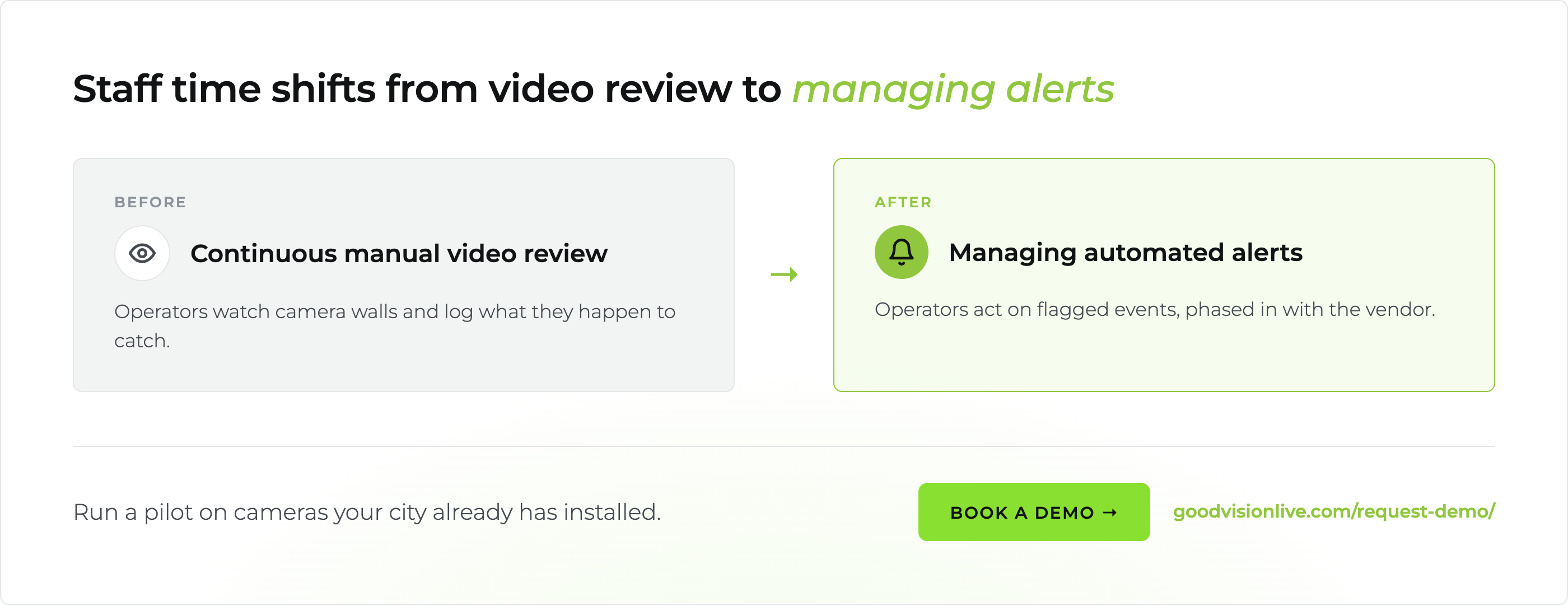
A third barrier is staffing. Real-time monitoring changes how a traffic management center works day to day, shifting staff from periodic manual review toward managing automated alerts. Without a plan for retraining or reallocating that team, IT and operations leads delay the rollout rather than absorb the disruption mid-budget-cycle.
Why Does Smart City Procurement Slow These Projects Down?
Smart city procurement slows real-time monitoring projects because most agencies still route software purchases through processes designed for physical construction. A loop detector installation has a design phase, a construction phase, and an inspection phase, and procurement teams build review cycles around that sequence. A software license has none of those phases, but it often gets pushed through the same review anyway, adding months of approvals that have no equivalent risk to justify them.
Data governance compounds the delay. IT and legal teams reviewing an AI vendor for the first time frequently have no existing checklist for video data retention, GDPR compliance, or data ownership, so the review defaults to the slowest, most conservative path available. Vendors that arrive with clear documentation on data ownership and camera-agnostic deployment, so IT does not have to approve new hardware on the network, move through that review meaningfully faster than vendors who leave those questions for a later meeting.
Procurement inertia is not unique to traffic software. It shows up across urban infrastructure technology generally, and it is one reason choosing the right traffic control software starts with mapping internal approval steps before evaluating vendors, not after.
How Do Cities Get Past These Barriers?
Cities get past these barriers by treating the software procurement track as separate from capital works, and by piloting on infrastructure they already own before any hardware conversation starts. GoodVision Live Traffic runs on existing CCTV, which means an operations team can pilot on a single intersection or highway segment before any hardware purchase, then expand once the pilot proves out.
Attikes Diadromes, which operated the Attiki Odos highway until October 2024 and now maintains most activities on it, deployed GoodVision Live Traffic for real-time counts and vehicle categorization, incident hotspot identification, toll booth allocation and heavy maintenance window planning. The highway already had cameras in use for incident detection, and twelve more were installed at critical locations to capture bi-directional flows for the project. That is the realistic shape of one of these deployments, and it is still the pattern that unblocks a delayed project: the existing camera network carries most of the coverage, new hardware goes only where the data requires it, and the pilot rather than a vendor's sales deck carries the procurement conversation.
Cities that get this right also stop treating data ownership and GDPR compliance as a late-stage legal review. Bringing documentation forward, alongside a clear answer to how traffic control software handles data security, shortens the review cycle that otherwise runs in parallel with, and often longer than, the technical evaluation. For a fuller picture of what a monitoring platform needs to clear internal review, see what cities need in real-time traffic monitoring software.
None of this replaces sound traffic data analysis once the system is live. It only removes the procedural steps that keep a proven platform sitting in review instead of running on a city's own cameras. The U.S. Department of Transportation's Intelligent Transportation Systems Joint Program Office publishes guidance on exactly this kind of deployment planning for agencies weighing new monitoring technology against legacy systems, available at its.dot.gov.
FAQ
-
What does real-time traffic monitoring software actually do?
It processes live camera or sensor feeds continuously and returns traffic data, such as counts, classifications, and incident alerts, within seconds, instead of requiring a separate post-processing step after footage is collected.
-
Why do cities take so long to adopt it if the technology works?
Delays come from procurement processes built for physical infrastructure, unclear internal ownership of the data governance review, and integration questions with legacy hardware, not from the software's performance.
-
Does real-time monitoring require new cameras or sensors?
Not to start. GoodVision Live Traffic is camera-agnostic and runs on existing CCTV, so a city can pilot on the cameras it already operates. Cameras get added later only where coverage gaps require them, as on the Attiki Odos project, where twelve were installed to capture bi-directional flows.
-
How fast is a "real-time" alert in practice?
GoodVision Live Traffic delivers incident alerts to operators in under 1 second over HTTPS.
-
What should a city ask a vendor before starting a pilot?
Ask for a named validation method behind any accuracy claim, documentation on data ownership and GDPR compliance, and confirmation that the platform works with cameras already installed.
-
Does adopting real-time monitoring replace existing traffic operations staff?
No. It shifts staff time from continuous manual video review toward managing automated alerts, which is why a phased rollout plan with the vendor matters more than a single go-live date.
Book a demo at goodvisionlive.com/request-demo/ and run a real-time monitoring pilot on cameras your city already has installed.