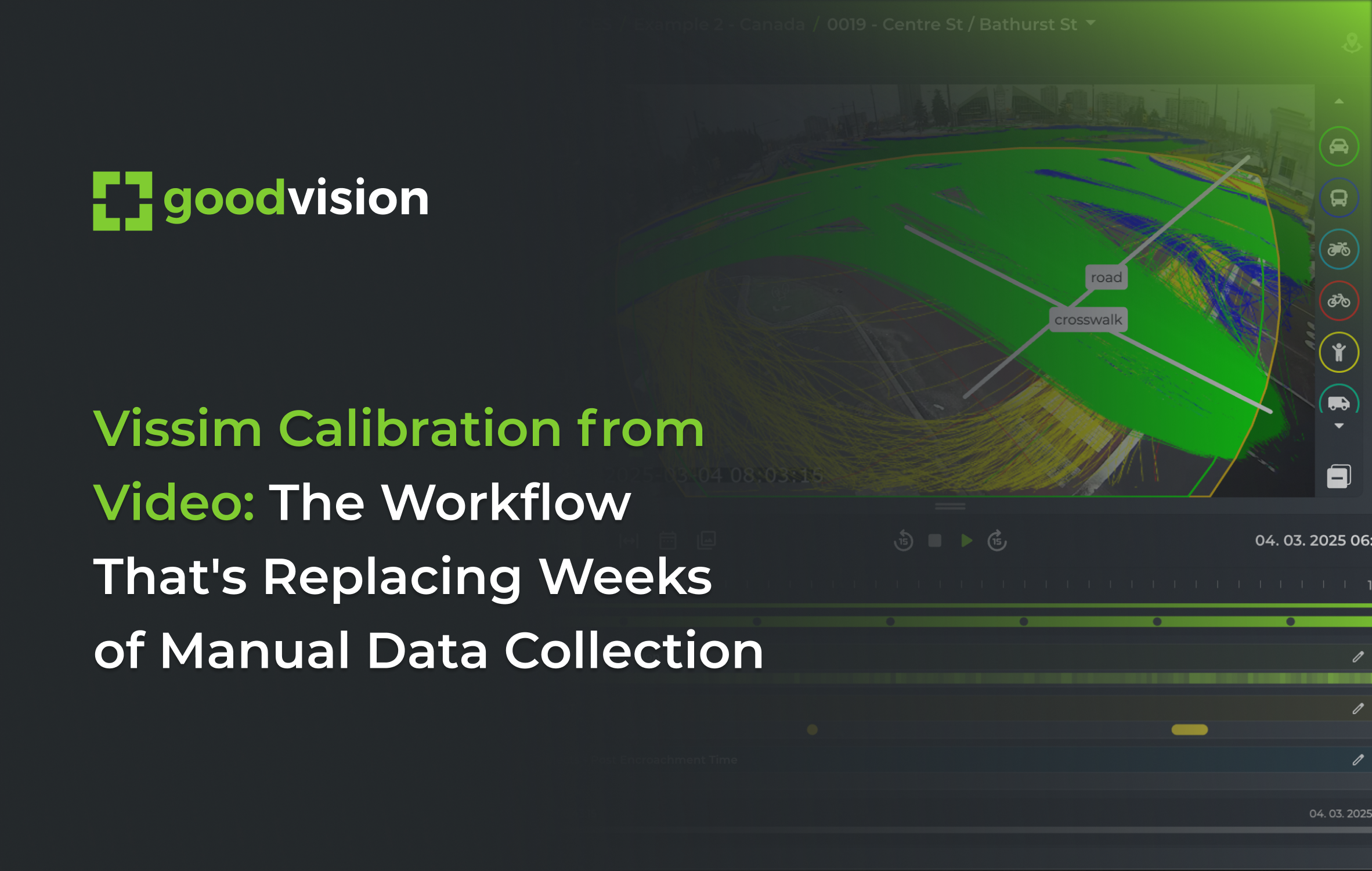
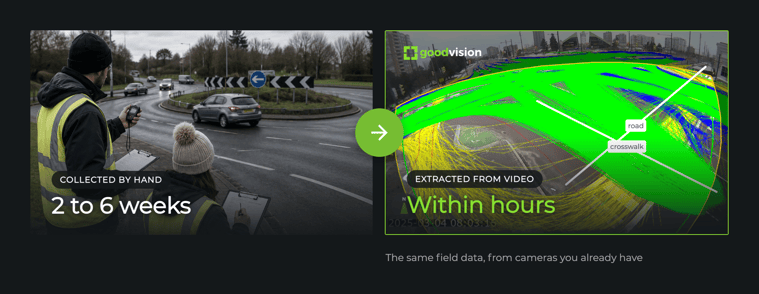
Calibrating a Vissim model still starts the same way it did fifteen years ago: someone stands at an intersection with a clipboard, or a field crew sets up cameras and spends the next two weeks manually reviewing footage frame by frame. Turning movement counts, gap acceptance data, saturation flow rates, all of it collected by hand, then re-keyed into spreadsheets before it ever touches the model.
That process was tolerable when project timelines were measured in months. It's a liability now. Clients want calibrated models faster, junior engineers are stuck doing tedious counting work instead of analysis, and every hour spent on data collection is an hour not spent validating the model itself. The bottleneck in most Vissim projects isn't the simulation software. It's what happens before you ever open it.
Video-based data extraction closes that gap. You get the same field data (turning movements, headways, gap acceptance, saturation flow) but pulled automatically from footage you already have, with results back within hours instead of weeks.
What Data Does a Vissim Calibration Need?
Calibrating a PTV Vissim microsimulation model to match real-world conditions means feeding it five field inputs:
- Turning movement counts at each intersection, by approach and movement.
- Vehicle classifications, including pedestrians and cyclists where they affect capacity.
- Saturation flow rates for every signalized approach.
- Gap acceptance behavior for unsignalized movements.
- Origin-destination patterns for larger networks.
Each of these needs to reflect what's actually happening on the road, not an estimate or a national default.
Gap acceptance is a good example of why this gets hard. It's the analysis of how drivers judge and accept gaps in conflicting traffic (turning across oncoming lanes, merging into a through movement) and it directly drives the priority rules and reduced speed areas you build into the model. Getting it wrong means your simulated queue lengths and delays won't match what your client sees on site.
Saturation flow is the other input that quietly determines whether your model behaves realistically. It's the maximum rate vehicles can discharge from a signalized approach under saturated conditions, and it sets your capacity assumptions for every downstream metric: delay, level of service, queue length. If you're using default values instead of site-measured rates, your calibration is built on a guess.
Why Manual Collection Breaks Down at Model Scale
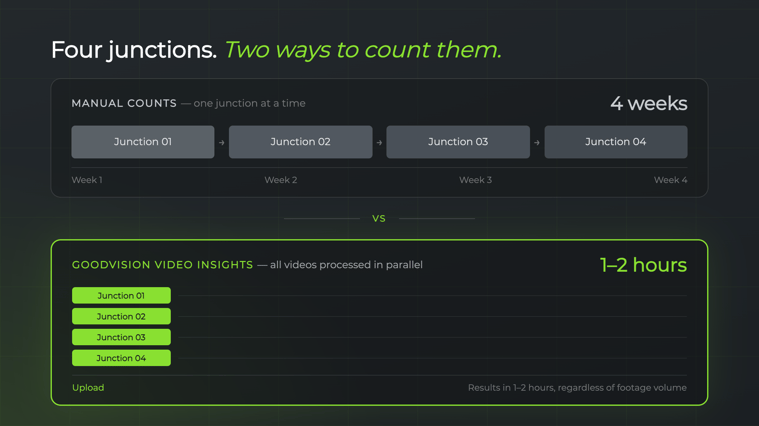
A single-intersection study can absorb a day or two of manual video review. A network model with a dozen intersections, multiple time periods, and gap acceptance data for every unsignalized movement cannot. The math doesn't work.
Manual review also introduces the kind of inconsistency that undermines a calibrated model before it's built. Different analysts count differently. Fatigue sets in over hours of frame-by-frame review, and small classification errors compound at intersections with mixed traffic, cyclists, and pedestrians. When Vissim's outputs get compared against field data in a validation report, or used in a client deliverable, that inconsistency shows up as noise you can't explain. Model acceptance is normally judged with the GEH statistic, which measures how far modelled flows sit from observed ones, and that test is only as sound as the counts behind it.
There's also the sequencing problem. Manual counts for one intersection have to finish before the next can start, unless you scale up the field crew, which scales up cost. A network-level calibration project ends up gated by however many analysts you can put on it, not by how much data you actually need.
How GoodVision Gets You There Faster
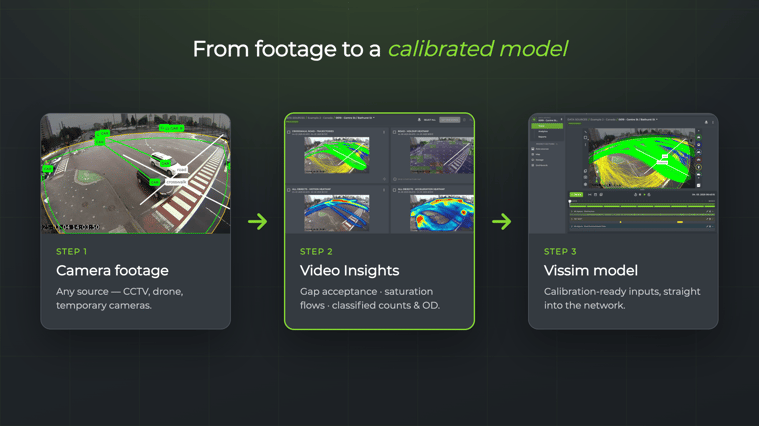
GoodVision's Video Insights platform processes uploaded footage in parallel across the cloud, so a two-hour survey and a twenty-hour dataset both come back within hours, not days. You get turning movement counts, saturation flow rates, and gap acceptance data extracted automatically, with 95%+ accuracy on vehicle classification validated against manual counts, and results structured for direct import into Vissim.
That accuracy matters most on the road users that are hardest to count by hand: pedestrians and cyclists at busy junctions, where manual counters miss the most and where GoodVision's classification consistently outperforms other AI counting tools. If your model needs multimodal calibration, this is where the difference actually shows up in your data.
IDOM used this approach for transport planning work in Warsaw, replacing manual survey crews with video-based extraction across multiple sites. Anton Rabizo, a traffic engineer on the project, put it plainly: there was way less stress on the projects compared to human counters, enough that it's now their preferred method going forward. That's the practical outcome consultancies are after: fewer field logistics, fewer analyst hours, and a calibration dataset you can defend in a client report.
If you want the mechanics of the full workflow, from footage upload to gap acceptance report, see how to save 95% of your time on Vissim calibration with GoodVision and our step-by-step breakdown of cutting calibration time from video. For the methodology specifically, our step-by-step guide to gap acceptance analysis in Video Insights walks through how the analysis is structured, and saturation flow automation covers how discharge rates get calculated without a stopwatch. You can read the full IDOM case in the Warsaw transport planning case study.
For methodology on saturation flow and gap acceptance definitions more broadly, the Highway Capacity Manual guidance from the Transportation Research Board and PTV Group's own Vissim documentation are useful references if you're building out calibration parameters from scratch.
Manual counting isn't going away entirely, and there are still edge cases where a person on site is the right call. But for the bulk of the data a Vissim calibration needs, the workflow has already shifted. The question isn't whether video-based extraction is accurate enough. It's how much longer your team wants to spend on a clipboard when the data is sitting in footage you already have.
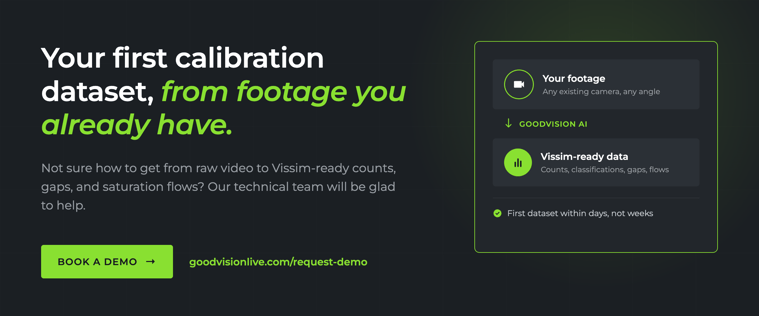
Book a demo at goodvisionlive.com/request-demo/ and run your first Vissim calibration dataset from existing footage within days.